Category Archives: History

Re-Patterning

Dear friends –
When all seems dead & barren on the face of the Earth, below the surface, the inner life is strengthened…& if we can let go of the false hustle & bustle imposed on us from without, & sit in the stillness of the darkness, where the heart-beat can be heard, There we will find the inner strength to let go of our fear of the dark. To let our eyes adjust to the dark. And soon we will see quite clearly in the dark. And then we can begin the work of Re-Patterning & opening to the inspiration of our Immaculate Conception – our pure thought, which creates the new paradigm…

Energizing Hope for the Sun’s return & the Earth’s renewal we make a ‘spiritual manger’ – a sacred space – in the cold black frozen places, that seem devoid of life, but are really just a sterilized palate – a clean slate, fresh & ready for the newly conceived light to be born into & fill…

At Advent, All our souls are pregnant with the possibility of giving birth to the light within. Wisdom fills us with this possibility that we may birth the Being of Love. This pure light is a becoming, it becomes, a rainbow, in us: shining with the colors of hope, truth & goodness; radiant with the hues of integrity, beauty & virtue, which overflow as joyous praise. In growing this rainbow within, we become, enlightened, with Good Will, bringing the power of Peace to bear in the world.
~hag

A contemplation for our 10:10 Thought-Seed:

Powerful beings who inhabit the spiritual worlds look with satisfaction and approval upon our thoughts about their world. They can help us only if we think about them; and although we may not have attained to clairvoyant vision into the spiritual world, if we know about these spiritual beings they can help us. In return for our study of spiritual science help comes to us from the spiritual world. It is not merely the things we learn, the knowledge we acquire, it is the beings of the higher Hierarchies themselves who help us when we know about them[…] The spiritual world helps us. We have need of it, we must know about it, and unite ourselves with it through conscious understanding“. ~ Rudolf Steiner – GA 168 – How Can the Destitution of Soul in Modern Times Be Overcome? – Zurich, October 10th, 1916

Chart via John Jardine Goss/ EarthSky.

17 December 2022 – “Speaking with the Stars”: You can see all 5 bright planets in the early evening sky in December 2022. You’ll need to start looking soon after sunset, because Venus and Mercury are close to the sunset glare. Saturn, Jupiter and Mars will be easy to spot, with Jupiter and Mars brighter than the brightest stars. As the month progresses, Venus will take its rightful place as the brightest of them all. And along with Mercury will be farther from the sunset, and easier to see. Beginning around December 24 – Christmas Eve and Christmas Day – you can watch as the waxing crescent moon begins moving up past the line of planets.

Hibiki Miyazaki

Rudolf Steiner’s Lectures on this day 

 ON THIS DAY IN HISTORY

Feast day of Lazarus – The biblical narrative of the raising of Lazarus is found in chapter 11 of the Gospel of John. Lazarus is introduced as a follower of Jesus, who lives in the town of Bethany near Jerusalem, the brother of Mary & Martha. The sisters send word to Jesus that Lazarus, “he whom thou lovest,” is ill. Instead of immediately traveling to Bethany, Jesus intentionally remains where he is for two more days before beginning the journey.

When Jesus arrives in Bethany, he finds that Lazarus is dead & has already been in his tomb for four days. He meets first with Martha & then Mary in turn. Martha laments that Jesus did not arrive soon enough to heal her brother & Jesus replies with the well-known statement, “I am the resurrection, and the life: he that believeth in me, though he were dead, yet shall he live: And whosoever liveth and believeth in me shall never die”. Later comes the famous simple phrase, “Jesus wept”.

In the presence of a crowd of mourners, Jesus comes to the tomb. Over the objections of Martha, Jesus has them roll the stone away from the entrance to the tomb & says a prayer. He then calls Lazarus to come out (“Come forth”) & Lazarus does so, still wrapped in his grave-cloths. Jesus then calls for someone to remove the grave-cloths, & let him go.

The narrative ends with the statement that many of the witnesses to this event “believed in him.” Others are said to report the events to the religious authorities in Jerusalem.

The Gospel of John mentions Lazarus again in chapter 12. Six days before the Passover on which Jesus is crucified, Jesus returns to Bethany & Lazarus attends a supper that Martha, his sister, serves. Jesus & Lazarus together attract the attention of many & the chief priests consider having Lazarus put to death because so many people are believing in Jesus on account of this miracle.

The miracle of the raising of Lazarus, the longest coherent narrative in John aside from the Passion, is the culmination of John’s “signs”. It explains the crowds seeking Jesus on Palm Sunday, & leads directly to the decision of Caiaphas & the Sanhedrin to kill Jesus.

It is notable that at John 11:11, after being told by His disciples to fear those who would kill Him, & after the parable about living in darkness, Jesus references his own parable & states that Lazarus sleeps, & that He will go “wake him up”. The disciples thought Jesus meant Lazarus was actually sleeping in verse 12. Then, in verse 14, Jesus speaks plainly & tells them that “Lazarus has died”. This is to be clear that Lazarus has died in the flesh, & is not sleeping but going thru the 1st Christian initiation.

Lazarus is spoken of by Rudolf Steiner as becoming John, the disciple whom Jesus loved, & formerly as Hiram Abiff the Master Builder of Solomon’s Temple & Christian Rosenkreutz.

Antoine Callet

497 BC – The first Saturnalia festival was celebrated in ancient Rome.

1790 – The Aztec calendar stone is discovered at El Zócalo, Mexico City.

1819 – Simón Bolívar declares the independence of Gran Colombia in Venezuela. Gran Colombia was the most prestigious country in Spanish America. John Quincy Adams, then Secretary of State & future president of the United States, claimed it to be one of the most powerful nations on the planet. This prestige, attracted to the nation unionist ideas of independence movements in Cuba, the Dominican Republic & Puerto Rico, which sought to form an associated state with the republic.

1833 – Deathday of Kaspar Hauser, the rightful Prince of Baden, died after a murder attempt on 12.12.1833

1873 – Birthday of Eleanor Charlotte Merry, an English poet, artist, musician & anthroposophist with a strong Celtic impulse & interest in esoteric wisdom. She studied in Vienna & met Rudolf Steiner in 1922 after becoming interested in his teachings. She went on to organize Summer Schools where Steiner gave lectures, & was secretary for the World Conference on Spiritual Science in London in 1928

Eleanor Charlotte Kynaston grew up in a liberal educational environment, her father being the well known classical scholar & professor of Ancient Greek, Herbert Snow aka KynastonIt was only at the age of 13 that she began to attend a regular school. This was also when she began to take a passionate interest in music. Two years later, her father became Deacon of Durham, so Eleanor grew up close to the beautiful cathedral. She was able to read the manuscripts that were kept in the monastic library, walking up & down amongst the Norman columns of the cathedral & experienced something of a real, concrete history, something completely different from what she read in her schoolbooks. It was the myths & legends that captivated her, & she learned by heart Tennyson’s King Arthur.

The stream of scholars & theologians that entered their house fed her spiritual longings.

As she grew up, she sought a career as singer, wanting to study music & art. At 19, she left home for a course of study in Vienna, which led not only to a fine command of the German language & development of her musical skills but also placed her in a kind of artistic-aesthetic inner crisis. Soon after her return to England, she married the well-known Oxford surgeon Merry, to whose professional commitments Eleanor Merry was to devote much of her energy besides the rearing of their son & daughter.

She learnt about Theosophy at the beginning of World War I when a copy of the “Secret Doctrine” of H.P. Blavatsky was sent her by persons unknown. As she read it, she felt as if guided by some unseen hand, & studied further works of Annie Besant & other Theosophists. After the war, she was made aware of Rudolf Steiner’s Knowledge of the Higher Worlds. In January 1922 she met Daniel Nicol Dunlop in London for the first time. He was reading a lecture of Rudolf Steiner’s to the anthroposophical group there. A few months later, her husband died of pneumonia, after which she had her first personal conversation with DN Dunlop. Dunlop was still fired up with gratitude over his meeting with Rudolf Steiner some few weeks previously.

She took part in the conference “Spiritual Values in Education” in Oxford that August, where she met Rudolf Steiner personally for the first time. She saw him first in a corridor & by his gait & the manner in which he looked at her, she had the impression: “He knows where he is going.”

She assisted D.N. Dunlop in the preparation of the subsequent Summer School in Penmaenmawr the following year, where a further conversation with Rudolf Steiner took place in which he recommended to her the new techniques in painting that had been developed under his guidance. She was soon exhibiting publicly in London& elsewhere. He also advised her to form as strong a bond as possible with Dunlop. This summer school, devoted to the theme “The Evolution of Consciousness” was felt by Steiner to be a milestone in the development of the anthroposophical movement.

Eleanor was present at the founding of the new General Anthroposophical Society at the Goetheanum in Dornach, Switzerland around New Year 1923/24.

The theme of the ensuing Summer School at Torquay in 1924, “True and False Paths in Spiritual Investigation” (GA 243), stemmed from a conversation she had with Rudolf Steiner on this occasion.

In her further work in Britain after Rudolf Steiner’s death, she wholeheartedly supported D.N. Dunlop’s efforts to create an open, inclusive & at the same time spiritually founded continuation of the anthroposophical work. She acted as secretary of the anthroposophical World Conference in London of 1928 &wrote a play around the figure of King Arthur for the youth conference initiated by David Clement in Glastonbury in 1932. More immediately than anyone, she experienced the dramatic events affecting Daniel Dunlop between 1929, when he became General Secretary of the Anthroposophical Society in Great Britain & the spring of 1935, when he was expelled from the General Anthroposophical Society & died a short while later. After his death, she maintained intimate friendships with her half-sister, Marna Pease, Walter Johannes Stein & particularly Eugen Kolisko, whom she helped to build up the School for Spiritual Science, wrote numerous articles for their magazine “The Modern Mystic“, & wrote down the biographical notes Kolisko dictated to her. In the 1940s she led a painting school together with Maria Schindler as well as working with her on the book Pure Colour (1946), leading to large public exhibitions.

Jane Hudson

POD (Poem Of the Day)

~i’ve known that tempting feast of death when
while darkness filled the mind, the heart cried out –
let us listen & hear…
i know when the eye of truth
is plucked from the head,
only the blood of rage remains –
Can we make the change
to heal the Comforter?
Come & Call forth with me
a bright secret veiled in black cloth –
a heart-light beyond heaven which is the light within
re-kindled through sacrifice…

~hag

The 4th Sunday of Advent – 18 December 2022 
at the Rudolf Steiner Branch Chicago, 2 pm – 3:30 pm CST 
(after Rev. Jonah Evans talk at the Christian Community)

The Individuality of Conscience and the Goetheanum 
with Lucien Dante Lazar

Out of our conscience, we witness the Christ in the other. And through this Seeing, our I is born within us, whose self-conscious interior is the I of God. This is a mystery of John the Baptist.


When Love enters the human heart as an awakening to freedom, the Wisdom of form enters our awareness, and color, that majesty of Light, teaches us about creation. This is a mystery of the painter Raphael.

When the Word approaches us, inspiring us in our language to find the Heavenly Sophia as intellect, we write truth and honor the New Revelation of the Christ and His marriage to Sophia. And out of this marriage, we learn about ourselves. This is a mystery of Novalis.

On this last Sunday of Advent dedicated to the Human Being & the Angels, we will engage in these three Christian gifts through the social encounter, our working with color, and our thinking through language. And we will strive to harmonize these three incarnations of this significant individuality with the birth, death, and resurrection of the Goetheanum.

$10-$50 or pay what you will at the door or online www.rschicago.org/donate(credit card or PayPal)

For more Info. contact Cultural Events & Festivals Coordinator 
Hazel Archer-Ginsberg
Rudolf Steiner Branch 4249 North Lincoln Avenue, Chicago, IL 60618 (map) 
https://www.rschicago.org/happenings/calendar 
www.rschicago.org/donate

Resurrection of the Temple (The first Goetheanum) by Rita de Cassia Perez, Adriana’s mother

The ‘Envy of the Gods’ – The ‘Envy of Human Beings’

Presented by Adriana Koulias*

A Winter Solstice offering preparing us for the Centennial commemoration

of the burning of the first Goetheanum.

21 December 2022, at 5 pm PT, 6 pm MT, 7 pm CT, 8 pm ET

Here is a link to the World Clock for your time zone

Online & in-person at the Rudolf Steiner Branch Chicago

Dear Friends – This special presentation is supported by your generous donations. $10-$50 or pay what you will www.rschicago.org/donate (credit card or PayPal)

Please type ‘Adriana’ to designate your payment

For those attending in-person doors open at 5:30 pm for our Potluck meal.

Please bring food & drink to share.

For more Info. contact Cultural Events & Festivals Coordinator Hazel Archer-Ginsberg

Rudolf Steiner Branch 4249 North Lincoln Avenue, Chicago, IL 60618(map) https://www.rschicago.org/happenings/calendar www.rschicago.org/donate

You are invited to a scheduled Zoom meeting.

Topic: Adriana Koulias

Time: Dec 21, 2022, 07:00 PM Central Time (US and Canada)

Join Zoom Meeting

https://us06web.zoom.us/j/89586637726

Meeting ID: 895 8663 7726

One tap mobile

+13092053325,,89586637726# US

+13126266799,,89586637726# US (Chicago)

Find your local number: https://us06web.zoom.us/u/kbtvb8sTRI

 Work on building the First Goetheanum, which was designed and supervised by Rudolf Steiner, began after the laying of the double dodecahedron foundation stone on the 20th of September 1913. Construction proceeded for a decade under enormous difficulties in the political, economic and cultural realms, brought on by the advent of the First World War. After the war when the building was near completion, the First Goetheanum was destroyed by an arsonist on New Year’s Eve 1922/1923.

This NYE 2022-23 will be the 100th anniversary of this event and the world is again facing many difficulties, political, economic and social.  Adriana’s lecture will explore what Rudolf Steiner meant by the ‘Envy of the Gods and the Envy of Human beings’ and how a consciousness of this during the coming 12 Holy Nights can provide the necessary strengthening for the coming twelve months.

During this presentation Adriana will speak about the three gifts given by Rudolf Steiner in 1913: The naming of Anthroposophy, The Fifth Gospel, and The Laying of the Foundation Stone of the First Goetheanum. She will explore with us how we can link our hearts to the old Goetheanum during the coming 12 Holy Nights to prepare ourselves for the coming 12 months in 2023, so we can work towards a Cosmic New Year.

In this way we will celebrate the Jubilee of the Christmas Conference and the resurrection of the living impulse of the First Goetheanum in the most auspicious way.

For Rudolf Steiner tells us: ‘My dear friends, may this link our hearts to the old Goetheanum which we had to consign to the elements. May it link our hearts also to the Spirit, to the Soul of this Goetheanum. With this vow before whatever is best within our being we want to live on not only into the new year. In strength of deed, bearing the spirit, leading the soul we want to live on into the new cosmic year.’ ~Rudolf Steiner, ‘The Envy of the Gods and the Envy of Human Beings.’

Adriana Koulias was born in 1960 in Brazil. Adriana moved to Australia when she was 9 years old where she lives today. She has studied art, operatic singing and nursing.  She has been studying Anthroposophy (awareness of our humanity) as given by Rudolf Steiner for 33 years and has since 2002-3 integrated this knowledge into several novels and a number of books, international lectures and articles online and in magazines.

Bride of Light

What do Norse Vikings, Swedish farmers, an Italian peasant girl, & an English Bishop have in common? Well since today is the feast of St. Lucia you have a clue. The interesting story is in who & the why. Let’s start with the Norse Vikings. According to the old Julian calendar, December 13 was the darkest day. In modern times with our Gregorian calendar, we know this to be the Winter Solstice, usually falling on December 21st or 22nd; the shortest day & the longest night for those of us, like the Vikings, in the Northern Hemisphere. This darkest day was not a day to be out on a boat, better to be inside, possibly by a hardy fire to keep warm -a tradition that would later become part of the winter festival – the burning of the Yule Log. But in those days, December 13 was the time of year when the ancient pagan Scandinavian farmers offered sacrifices in honor of the Goddess of good crops for the coming summer. These sacrifices would usually involve building a ceremonial fire to light the night.

The name Lucia comes from Lux which means light. An old legend from Sweden, names Lucia as the bride of light. The story says that on December 13, Lucia will appear riding in a lusse-cart, similar to a chariot, & if the cart breaks down, you will get lice in your hair. On Lucia night, the threshing of grain must be finished to insure a bountiful crop the next year, the horses should have on winter shoes, & all new-born babies should be baptized before Lucia night or the trolls would come & whisk them away forever. The people who lived in Vermland claimed Lucia was the queen of supernatural beings & was a worker of miracles.

To understand why we celebrate St. Lucia Day today, we need to look at the actual person. An English bishop from the Seventh Century, St. Aldhelm, gave us the story of St. Lucia as we know it today.

St. Mark’s Basilica,  Venice, Chiesa d’Oro

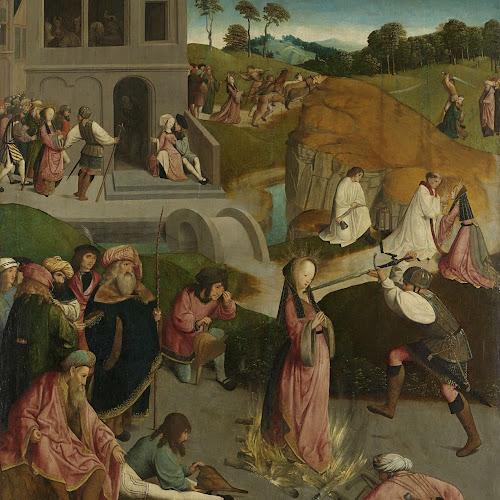
Santa Lucia was born around the year 300 A.D. to a wealthy Sicilian family. Although her father died when she was a baby, he left plenty of money for Lucia & her mother to be cared for. As she grew Lucia learned of The Christ & was raised in the Christian faith. She made a secret vow never to marry but instead to spend her life serving the poor. Her mother was unaware of this vow, & pressed her to marry a man who was pagan. Although she resisted, Lucia became engaged to this man.

Gruesome martyrdom of St. Agatha

Around that time, her mother suffered from unexplained bleeding, & Lucia persuaded her to go to the tomb of St. Agatha to pray. Miraculously, her mother was healed. After this, Lucia told her mother of her vow never to marry, & persuaded her that in gratitude to God they should give away their wealth to the poor of the city. So, by candlelight, the mother & daughter went about the city secretly ministering to the poor. Some even said she would bring food to the poor people living in caves, & that because she needed both hands to carry the food, she strapped candles to her head.

As a result of her vow, the young man she had been engaged to was furious. Not only did he lose the opportunity of having the beautiful Lucia as his wife, he also missed out on the great amount of money that would have been her dowry that he would have received in the event of their marriage. He went to the governor & accused her of both being a Christian, & aiding other Christians. At that time, it was illegal to be a Christian. Lucia was called before a judge & given the chance to renounce her faith, but she refused.

The judge ordered her to be taken away & executed, but the soldiers who came to drag her away could not budge her. Instead, they put wood around her & laid a fire beneath her, but the fire would not light. Finally, the judge called forth one of the soldiers & told him to kill her with his sword, which he did.

Many years later, Sweden was in the grip of a terrible famine. At the height of that dark, icy winter, hunger & suffering were at their worst. People were reduced to grinding tree bark to bake into bitter bread. But on the long night of Santa Lucia Day a brilliantly lit ship came sailing across the stormy waters of Lake Vannern. At the helm stood a beautiful young woman dressed all in white, with a face so radiant that there was a glow of light all about her head. As the vessel touched shore, great quantities of food & clothing appeared with her for the starving. When asked her name, she simply replied “Lucia”. When all were fed & cared for, the vessel disappeared as quickly as it had come. To this day, the people of Sweden celebrate the remembrance of Lucia, & how she came to save the people of their country.

The emblem of eyes on a cup or plate recalls her torture & suffering & reflects popular devotion to her as protector of the light which brings sight. In paintings St. Lucy is frequently shown in Gothic art holding her eyes on a golden plate. She also holds the palm branch, symbol of victory over evil.

The story of St. Lucia resonated particularly in Scandinavia where it became mingled with those earlier Norse legends. Today it is one of the very few saint days observed in Scandinavia. Put the two together, the religious & the folklore, & you create a warm & joyous day dedicated to the finding of light in the darkness.

My daughter, who attended the YIP program in Jarna Sweden can attest that they do indeed celebrate this joyful fest, which begins before dawn. Traditionally it is the oldest girl in the family rising to make saffron buns & coffee for her parents. She wears white, with a red sash & a wreath of candles on her head. Other girls in the family are dressed in white as attendants & the boys are dressed as “star boys” with pointy star hats.

Sulamith Wulfing

In the pedagogy of the Waldorf schools, the 2nd grade studies the Saints, so they take up this festival. The youngest in the class wears the candle crown & the class processes thru the hallways singing:
Santa Lucia, Thy light is glowing
All through the darkest night, comfort bestowing
Dreams float on wings of night,
Comes then the morning light
Santa Lucia, Santa Lucia

Through silent winter gloom, Thy song comes winging to
Waken the Earth anew, Glad carols bringing,
Come thou, oh queeen of Night,
Wearing thy crown so bright,
Santa Lucia, Santa Lucia

Santa Lucia, Christmas foretelling,
Fill hearts with hope and cheer, Dark fear dispelling,
Bring to the world’s call,
Peace and goodwill to all,
Santa Lucia, Santa Lucia

Falling within the Advent season, Saint Lucy’s Day is viewed as an event signaling the arrival of Christmastide, pointing to the birth of the Light on Christmas Day. It is said that to vividly celebrate Saint Lucy’s Day will help one live the long winter days with enough light.

Della Bazel

What would it be like to use this feast day as an opportunity to ‘see’ the growing darkness with eyes of hope, knowing that in the dark womb the light will be reborn, again & yet again.

~hag

13 December 2022 – “Speaking with the Stars”: Nature brings us its own version of holiday lighting with the annual return of the luminous Geminid meteor shower.

Elisabet Megner

Rudolf Steiner’s Lectures on this day

 ON THIS DAY IN HISTORY

662- Feast Day of Saint Odilia, patron saint of good eyesight, & of Alsace. Odilia was born blind. Her father did not want her because she was a girl & handicapped, so her mother had her brought to Palma where she was raised by peasants there. A tenth-century legend relates that when she was twelve, Odile was taken into a nearby monastery. While there, the itinerant bishop Saint Erhard of Regensburg was led, by an angel, to Palma where he baptized her Odile (Sol Dei), whereupon she miraculously recovered her sight. Her younger brother Hughes had her brought home again, which enraged her father so much that he accidentally killed his son. Odile miraculously revived him, & left home again.

She fled across the Rhine to a cave near Freiburg Germany. It is said the cliff face opened up in order to rescue her from her plight. In the cave, she hid from her father. When he tried to follow her, he was injured by falling rocks & gave up.

When her father fell ill, Odile returned to nurse him. He finally gave up resisting his headstrong daughter & founded the Augustine monastic community of Mont Ste. Odile in the Hochwald, Bas-Rhin, where Odile became abbess.

Some years later Odile was shown the site of Niedermünster at the foot of the mountain by St. John the Baptist in a vision. There she founded a second monastery, including a hospital. The local well is still said to cure eye diseases.

St. Odile died about 720 at the convent of Niedermünster. At the insistent prayers of her sisters she was returned to life, but after describing the beauties of the afterlife to them, she took communion by herself & died again.

Lussi Long-Night

1204 – Deathday of Maimonides, a medieval Sephardic Jewish philosopher who became one of the most prolific & influential Torah scholars of the Middle Ages. In his time, he was also a preeminent astronomer and physician. Born in Cordova, (present-day Spain) on Passover Eve he worked as a rabbi, physician, & philosopher in Morocco & Egypt.

During his lifetime, most Jews greeted Maimonides’ writings on Jewish law & ethics with acclaim & gratitude, even as far away as Iraq & Yemen, his copious work comprises a cornerstone of Jewish scholarship. He is sometimes known as “ha Nesher ha Gadol” (the great eagle) in recognition of his outstanding status as a bona fide exponent of the Oral Torah.

Aside from being revered by Jewish historians, Maimonides also figures very prominently in the history of Islamic & Arab sciences. Influenced by Al-Farabi, Avicenna, & his contemporary Averroes .He in his turn influenced other prominent Arab & Muslim philosophers and scientists. He became a prominent philosopher & polymath in both the Jewish & Islamic worlds.

Maimonides exerted an important influence on the Scholastic philosophers, especially on Albert the Great, Thomas Aquinas & Duns Scotus. He was a Jewish Scholastic. Educated by reading the works of Arab Muslim philosophers , he acquired an intimate acquaintance not only with Arab Muslim philosophy, but with the doctrines of Aristotle. Maimonides strove to reconcile Aristotelian philosophy & science with the teachings of the Torah.

1294 – Saint Celestine V resigns the papacy after only five months to return to his previous life as an ascetic hermit. He was elected pope in the Catholic Church’s last non-conclave papal election, ending a two-year impasse. Among the only edicts of his to remain in force was the confirmation of the right of the pope to abdicate; nearly all of his other official acts were annulled by his successor, Boniface VIII. On 13 December 1294, a week after issuing the decree, Celestine resigned, stating his desire to return to his humble, pre-papal life. He was subsequently imprisoned by Boniface in the castle of Fumone in the Campagna region, in order to prevent his potential installation as antipope. He died in prison at the age of 81. Celestine was canonized by Pope Clement V. No subsequent pope has taken the name Celestine

Image result for Donatello paintings

1466 – Deathday of Donatello, Italian painter & sculptor

1476 – Birthday of St. Lucy Brocadelli, mystic & stigmatic. Lucy was born in 1476 on the feast day of St. Lucia, the eldest of eleven children in the town of Narni (then called Narnia) in the region of Umbria. When she was only five years old, she had a vision of the Virgin Mary. Two years later, she had another vision, this time of the Virgin Mary accompanied by Saint Dominic. Dominic is said to have given her his scapular at this time. When she was twelve years old, Lucy made a private vow of chastity, & she determined to become a Dominican nun.

Her uncle tried to get her to marry Count Pietro di Alessio of Milan, an acquaintance of the family. Lucy was actually quite fond of him, but felt that her earlier vow of perpetual virginity made the marriage impossible. The strain Lucy felt as a result of the conflicting feelings made her seriously ill. During this time, the Virgin Mary & Saint Dominic again appeared to her, this time accompanied by St. Catherine of Siena. They reportedly advised Lucy to contract a legal marriage to Pietro, but to explain that her vow of virginity would have to be respected & not violated. Pietro agreed to the terms, & the marriage was formalized.

Lucy performed austere penances, which included regularly wearing a hair shirt under her garments & spending most of the night in prayer as well as helping the poor. The servants told her husband that Lucy was often visited in the evenings by Saint Catherine, Saint Agnes, & Saint Agnes of Montepulciano, who helped her make bread for the poor.

However, when one of the servants came up to him one day & told him that Lucy was privately entertaining a handsome young man she appeared to be quite familiar with. He took up his sword & went to see who this person was. When he arrived, he found Lucy contemplating a large crucifix. The servant told him that the man he had seen Lucy with looked like the figure on the crucifix.

Later Lucy left one night for a local Franciscan friary, only to find it closed. She returned home the following morning, stating that she had been led back by two saints. That was enough for Pietro. He had her locked away for the bulk of one Lenten season. She was visited only by servants who brought her food. When Easter arrived, however, she managed to escape from Pietro back to her mother’s house &, on 8 May 1494, became a Dominican tertiary. Pietro expressed his disapproval of this in a rather dramatic form—by burning down the monastery of the prior who had given her the habit of the Order.

The next year she was sent to Viterbo to establish a new convent & here she found she was frequently the object of unwanted attention, as she was reported to have received the stigmata. Lucy did her best to hide these marks, & was frequently in spiritual ecstasy. T

The local Prior Provincial of the Dominican Order would not permit any member of the Order to see her. There are records that at least one Dominican, Catherine of Racconigi, did visit her, evidently by bilocation, & that Lucy’s earlier visitations by departed saints continued. This punishment was to last her entire life. When she died her body was laid out for burial & so many people wanted to pay their last respects that her funeral had to be delayed by three days. Her tomb in the convent church was opened four years later & her perfectly preserved body was transferred to a glass case.

The 4th Sunday of Advent – 18 December 2022 
at the Rudolf Steiner Branch Chicago, 2 pm – 3:30 pm CST 
(after Rev. Jonah Evans talk at the Christian Community)

The Individuality of Conscience and the Goetheanum 
with Lucien Dante Lazar

Out of our conscience, we witness the Christ in the other. And through this Seeing, our I is born within us, whose self-conscious interior is the I of God. This is a mystery of John the Baptist.


When Love enters the human heart as an awakening to freedom, the Wisdom of form enters our awareness, and color, that majesty of Light, teaches us about creation. This is a mystery of the painter Raphael.

When the Word approaches us, inspiring us in our language to find the Heavenly Sophia as intellect, we write truth and honor the New Revelation of the Christ and His marriage to Sophia. And out of this marriage, we learn about ourselves. This is a mystery of Novalis.

On this last Sunday of Advent dedicated to the Human Being & the Angels, we will engage in these three Christian gifts through the social encounter, our working with color, and our thinking through language. And we will strive to harmonize these three incarnations of this significant individuality with the birth, death, and resurrection of the Goetheanum.

$10-$50 or pay what you will at the door or online www.rschicago.org/donate(credit card or PayPal)

For more Info. contact Cultural Events & Festivals Coordinator 
Hazel Archer-Ginsberg
Rudolf Steiner Branch 4249 North Lincoln Avenue, Chicago, IL 60618 (map) 
https://www.rschicago.org/happenings/calendar 
www.rschicago.org/donate

Resurrection of the Temple (The first Goetheanum) by Rita de Cassia Perez, Adriana’s mother

The ‘Envy of the Gods’ – The ‘Envy of Human Beings’

Presented by Adriana Koulias*

A Winter Solstice offering preparing us for the Centennial commemoration

of the burning of the first Goetheanum.

21 December 2022, at 5 pm PT, 6 pm MT, 7 pm CT, 8 pm ET

Here is a link to the World Clock for your time zone

Online & in-person at the Rudolf Steiner Branch Chicago

Dear Friends – This special presentation is supported by your generous donations. $10-$50 or pay what you will www.rschicago.org/donate (credit card or PayPal)

Please type ‘Adriana’ to designate your payment

For those attending in-person doors open at 5:30 pm for our Potluck meal.

Please bring food & drink to share.

For more Info. contact Cultural Events & Festivals Coordinator Hazel Archer-Ginsberg

Rudolf Steiner Branch 4249 North Lincoln Avenue, Chicago, IL 60618(map) https://www.rschicago.org/happenings/calendar www.rschicago.org/donate

You are invited to a scheduled Zoom meeting.

Topic: Adriana Koulias

Time: Dec 21, 2022, 07:00 PM Central Time (US and Canada)

Join Zoom Meeting

https://us06web.zoom.us/j/89586637726

Meeting ID: 895 8663 7726

One tap mobile

+13092053325,,89586637726# US

+13126266799,,89586637726# US (Chicago)

Find your local number: https://us06web.zoom.us/u/kbtvb8sTRI

 Work on building the First Goetheanum, which was designed and supervised by Rudolf Steiner, began after the laying of the double dodecahedron foundation stone on the 20th of September 1913. Construction proceeded for a decade under enormous difficulties in the political, economic and cultural realms, brought on by the advent of the First World War. After the war when the building was near completion, the First Goetheanum was destroyed by an arsonist on New Year’s Eve 1922/1923.

This NYE 2022-23 will be the 100th anniversary of this event and the world is again facing many difficulties, political, economic and social.  Adriana’s lecture will explore what Rudolf Steiner meant by the ‘Envy of the Gods and the Envy of Human beings’ and how a consciousness of this during the coming 12 Holy Nights can provide the necessary strengthening for the coming twelve months.

During this presentation Adriana will speak about the three gifts given by Rudolf Steiner in 1913: The naming of Anthroposophy, The Fifth Gospel, and The Laying of the Foundation Stone of the First Goetheanum. She will explore with us how we can link our hearts to the old Goetheanum during the coming 12 Holy Nights to prepare ourselves for the coming 12 months in 2023, so we can work towards a Cosmic New Year.

In this way we will celebrate the Jubilee of the Christmas Conference and the resurrection of the living impulse of the First Goetheanum in the most auspicious way.

For Rudolf Steiner tells us: ‘My dear friends, may this link our hearts to the old Goetheanum which we had to consign to the elements. May it link our hearts also to the Spirit, to the Soul of this Goetheanum. With this vow before whatever is best within our being we want to live on not only into the new year. In strength of deed, bearing the spirit, leading the soul we want to live on into the new cosmic year.’ ~Rudolf Steiner, ‘The Envy of the Gods and the Envy of Human Beings.’

Adriana Koulias was born in 1960 in Brazil. Adriana moved to Australia when she was 9 years old where she lives today. She has studied art, operatic singing and nursing.  She has been studying Anthroposophy (awareness of our humanity) as given by Rudolf Steiner for 33 years and has since 2002-3 integrated this knowledge into several novels and a number of books, international lectures and articles online and in magazines.

the Good Witch

Tessa Lingren

Folks often ask why I call myself ~hag. No, I was not born hag; I chose those initials because I want to reclaim the archetype of the Wise Crone. In our modern culture, the Crone is either invisible or scorned. If a woman is wise & powerful she is often feared or demonized. It’s true that we can often be direct, & outspoken, which in a woman is not prized.

The Crone is featured in many myths & fairytales. She is the witch – the haggard old woman who lives in the forest; a friend of death, feared by the uninitiated. From Hansel & Gretel to Baba Yaga, this archetype has become one to avoid. In folklore the Crone may also exhibit supernatural, magical abilities, either for helpful or obstructive purposes.

The ancient archetype of the Crone held a more holistic ideal & can be traced back to the Middle East, Balkans, Scandinavia & Ancient Greece.  For example, in Norse mythology the God Thor wrestled the crone Elli.

The word ‘crone’ only entered the English language around 1390. It was derived from the Anglo-French word ‘carogne’ (an insult), which itself was derived from the Old North French ‘charogne’ or ‘caroigne’, meaning a disagreeable woman (or literally “carrion”).

However, when we reclaim this archetype, The Crone is said to derive from another more positive origin, with the Word Crone coming from Crown, indicating wisdom emanating from the head. She plays the role of Hierophant or initiator, demanding seemingly impossible tasks, which are often only completed with the help of supernatural elemental beings.

Paula Belle Flores.

The crone aspect of the Female Metaphor is not just about age, it the mysterious time of the waning crescent, & dark Moon phases. It is about the acceptance & valuing of the darkness, as an essential life process. Once this aspect was connected to regeneration & acumen – Ancient cultures understood the dark as the source of being.

In a culture where the darkness is thought of as evil – where there is no place for the compost, this aspect is avoided or loathed. Where only the Light is valued as positive, where the nurturance of the Dark has been forgotten, real wisdom & compassion will never be realized.

If we are stuck in the duality of light vs. dark, good vs. evil, blue vs. red – or any other either/or frame of mind, we will never escape the prison walls of division – we will never escape the jailer – the executioner who divides one I from another.

Freedom is to be able to live in the frame of mind that is guided by an all-inclusive attitude, always able to consider & even accept contradiction, whose outlook on life & interaction with the world is not cause for division but guided by the searching for a higher unity.

The world has been run for too long by the analytical man-mind-set of either/or. A new womb-mind-set of ‘As Well As’ brings the opening to choice, & promotes both, with the heart in the center, weighing & balancing the 2 with the transcendent third.

And so let us write a new story, where we embrace the gifts of darkness, the hard truth of death in life, which makes true regeneration possible.

~hag  

***Listen to the podcast on this theme HERE

10 December 2022 – “Speaking with the Stars”: Cassiopeia the Queen is circumpolar – She circles around the north celestial pole, never dipping below the horizon. However, the best time to see Cassiopeia is during fall and winter evenings, since that’s when the constellation rides highest in the sky. The bright stars of Cassiopeia trace out an M or W, depending on its position in the sky and your perspective.

Scabolocs Bodo

 Rudolf Steiner’s Lectures on this day 

 ON THIS DAY IN HISTORY

Benjamin Jean Joseph Constant

According to the original Calendar of the Soul by Rudolf Steiner, Today is the Birthday of Judith. The book from the Apocrypha, named after her, tells the lesser known story of this beautiful widow who plied enemy Assyrian General Holofernes with cheese & wine until he fell into a drunken stupor. Judith then beheaded the general in his sleep, & his soldiers fled in fear, saving her people from the Assyrians. This story is the subject of much renowned artwork. And is told at Hanukkah.

1198 – Deathday of Averroes, Arabian philosopher, astronomer, most famous for his commentaries on Aristotle’s works, which had been largely forgotten in the West. It was through the Latin translations of Averroes’ work, beginning in the twelfth century, that the legacy of Aristotle was recovered in the West. Averroes attempted to reconcile Aristotelian philosophy with Islamic theology & to demonstrate that philosophy & theology were two paths to understanding the same truth. Rudolf Steiner refers to him a lot in his lectures on Karmic relationships.

1520 – The Burning the Papal Bull of Excommunication by Martin Luther. Because of constant attacks from the Roman Church, Luther was forced to shape his ideology into an autonomous theology. During the years 1520-1521 he worked on the three great works “Address to the Christian Nobility of the German Nation”, “The Babylonian Captivity” & “The Freedom of the Christian Man”, thereby emotionally cutting himself off from Rome.

The inquisition against Luther was taken up again in 1520, partly because of these works. The peak of the inquisition came, with the Papal Bull of excommunication in which Luther was ordered to recant his teachings.

Luther reacted in protest. He burned the Papal Bull (“Exurge Domine”) along with the book of church law & many other books by his enemies on December 10, 1520 in Wittenberg where the Luther Oak (Luthereiche) stands today. He is said to have yelled: “Because you, godless book, have grieved or shamed the holiness of the Father, be saddened and consumed by the eternal flames of Hell”.

This behavior caused a conclusive and irrevocable break with Rome. On January 3, 1521 the Pope excommunicated Luther.

The Emperor, however, felt forced to accept Luther because of the pro-Luther mood in the empire & because of the influence of various princes who were hoping to weaken the Pope’s political influence through Luther. As a result, the rebel was guaranteed safe escort on his trip to the Imperial Diet of Worms.

1884 – Birthday of Albert Steffen, poet, painter, dramatist, essayist, & novelist. He joined the Theosophical Society in Germany in 1910, & the Anthroposophical Society in 1912. He was 1 of the original Vorstand members, & became its president after the death of founder, Rudolf Steiner. Steffen was chief editor of the society’s journal, Das Goetheanum, from 1921-1963. At an early age his senses were especially attuned to all of nature. “As a child it always seemed to me as though a human countenance peeped forth from every blossom. From the tulip, that of a Turkish maiden; from the chrysanthemum, that of a Japanese dancer; from the sunflower of Inca King; from the geranium a Moorish boy.”~AS

By age 14 he had intuitively ‘understood’ that the human soul goes through the process of reincarnation. At age 21 he moved to Berlin, & 2 years later, to Munich. There he became a freelance writer & published his first novel, ‘Ott, Alois and Werelsche’ in 1907.

In Berlin, Steffen 1st heard a lecture by Rudolf Steiner. He writes: “I recognized immediately the leader of humanity: the wisdom on his brow, the love pervading his eye, the conscience in his word.”

In 1914, the beginning of World War I, Steffen was 29. At that time he was making frequent visits to Dornach. Of his experience there, he wrote: “Harmony reigned through a single man’s God-founded spirit,”…“Carving the Goetheanum capitals and architraves furthered me as a shaper of words.” In 1920, at the age of 35 Steffen moved to Dornach. In 1921 he was asked by Rudolf Steiner to be editor of the newly founded ‘Das Goetheanum’ weekly periodical.

On New Year’s 1923 Steffen witnessed the destruction by fire of the 1st Goetheanum, despite all efforts to save it. At the Christmas Conference Rudolf Steiner named Steffen to head the Section for Belles Lettres in the newly constituted Anthroposophical Society & named him Deputy Chairman. Of Albert Steffen he said: “The members of Vorstand are, I believe, chosen in the right way. Albert Steffen has already been an anthroposophist before he was born; this must be recognized with regard to him” (The Christmas Conference).

In an article which appeared in Das Goetheanum February 22nd, 1923, Steiner wrote about Steffen: “Within the Anthroposophical Movement, the spirit of such a poet, if rightly felt, should be experienced as the bringer of a message from the spiritual sphere.”… “That he wishes to work in this Movement, should be felt as a good destiny.”

F W Zeylmans van Emmichoven, a Dutch Anthroposophist, wrote that Rudolf Steiner wanted the members of the Vorstand to recognize themselves & each other against the background of the spiritual streams to which they belonged, “to cultivate fraternal feeling even between strongly contrasting personalities.”

Rudolf Steiner died in 1925; Steffen was with him in his last days. He expressed his reverence & thankfulness for this great initiate’s being & gift to humanity, recreating a ‘memory picture’ for the reader – ‘In Memoriam, Rudolf Steiner’.

After Steiner’s death, in accordance with his wishes, Albert Steffen became Chairman of the Society, serving to keep a center point of balance amidst contrasting personalities & divergent streams, which he was not able to do.

“Let this be for us our cosmic goal: –
To paint a living picture for the soul
which the claws of death cannot despoil,
which lights the darkest dungeon deep below –
take a new earth with us when we go,
which no evil shadow e’er can soil,
no tide nor flood can ever wash away,
no wind that blows can ever bleach or blight,
will never yield to acid’s poisoned bite,
will never melt in fire’s burning ray,
that’s brighter than the sun’s own visage is –
but only Christ himself can give us this!”

~Albert Steffen, Adonis Spiel / Eine Herbstfeier

Albert Steffen is also concerned with how the forces of growth & becoming are victorious. He writes: “Everywhere Christ emerges from the elements. With the lifting power with which he rolled the stone from the grave, support your body, with the light forces with which he permeates the plants, renew your life! With the air of heaven with which he sends you thoughts, like butterflies, fill your words. Guide your ego from rock to forest to the clouds, right up to the sun, by shaping, condensing, transforming and purifying it. Gaze upon your destiny from above, with starry eyes.” Steffen’s work is grounded in a living experience of the eternal. It conveys a quality which helps transform our consciousness of the earth, helping to redeem & heal.

One of Steffen’s friends was the American poet-dramatist Percy MacKaye. They spoke a similar inner language & conversed together through poetry. In an essay, ‘The Excellence of Albert Steffen’, Percy MacKaye seeks to describe his friend. “How shall I sketch his portrait for the reader? The solemnity of Savonarola, illumined by the radiance of Shelly, the staunch piety of William Penn (in black quakerish hat), all twinkled over and merrified by the arch smile and skipping gait of the marble faun himself – on a holiday, the athleticism of an alpine skier, subdued to the tender solitude of St Francis feeding the birds.”

In Steffen’s dramas one can discover interweaving themes. One is that of the victory of the spirit reborn in Christ over physical death & the forces of destruction & chaos. This is an aspect of the struggle for transformation of evil into good, a teaching of Manes who lived in the third century after Christ. Strength is called forth to release worn-out thought forms in order to grasp a deeper clarity; this leads to acts of sacrifice, inspired through love. Their example has a transforming effect, both on the people within the play & in the audience.

‘Friend’ – (from the Anglo-Saxon root: freon – to love) is defined as ‘one disposed to promote the good of another’. – Steffen describes how he aspires to view others: “The developed person does not judge others and thus set them back, but lets them stand and understands them.”

1896 – Deathday of Alfred Nobel, a Swedish chemist, engineer, inventor, businessman, & philanthropist. Known for inventing dynamite, Nobel also owned Bofors, which he had redirected from its previous role as primarily an iron & steel producer to a major manufacturer of cannon & other armaments. Nobel held 355 different patents, dynamite being the most famous. After reading a premature obituary which condemned him for profiting from the sales of arms, he bequeathed his fortune to institute the Nobel Prizes.

Holiday Market at the Rudolf Steiner Branch 
4249 N. Lincoln Ave. Chicago
TODAY! 10 December 2022 – from 11 am – 4 pm

Handcrafted gifts, décor & toys
Featuring Live Music, Puppetry & Candle Dipping!!!

If you would like to be a vendor contact Elizabeth Kelly 
eilisaineariadne@gmail.com

The 4th Sunday of Advent – 18 December 2022 at the Rudolf Steiner Branch Chicago, 2 pm – 3:30 pm CST (after Rev. Jonah Evans talk at the Christian Community)

The Individuality of Conscience and the Goetheanum with Lucien Dante Lazar

Out of our conscience, we witness the Christ in the other. And through this Seeing, our I is born within us, whose self-conscious interior is the I of God. This is a mystery of John the Baptist.

When Love enters the human heart as an awakening to freedom, the Wisdom of form enters our awareness, and color, that majesty of Light, teaches us about creation. This is a mystery of the painter Raphael.

When the Word approaches us, inspiring us in our language to find the Heavenly Sophia as intellect, we write truth and honor the New Revelation of the Christ and His marriage to Sophia. And out of this marriage, we learn about ourselves. This is a mystery of Novalis.

On this last Sunday of Advent dedicated to the Human Being & the Angels, we will engage in these three Christian gifts through the social encounter, our working with color, and our thinking through language. And we will strive to harmonize these three incarnations of this significant individuality with the birth, death, and resurrection of the Goetheanum.

$10-$50 or pay what you will at the door or online www.rschicago.org/donate (credit card or PayPal)

For more Info. contact Cultural Events & Festivals Coordinator Hazel Archer-Ginsberg – Rudolf Steiner Branch 4249 North Lincoln Avenue, Chicago, IL 60618 (map) https://www.rschicago.org/happenings/calendar www.rschicago.org/donate

Resurrection of the Temple (The first Goetheanum) by Rita de Cassia Perez, Adriana’s mother

The ‘Envy of the Gods’ – The ‘Envy of Human Beings’

Presented by Adriana Koulias*

A Winter Solstice offering preparing us for the Centennial commemoration of the burning of the first Goetheanum.

21 December 2022, at 5 pm PT, 6 pm MT, 7 pm CT, 8 pm ET Here is a link to the World Clock for your time zone

Online & in-person at the Rudolf Steiner Branch Chicago

Dear Friends – This special presentation is supported by your generous donations. $10-$50 or pay what you will www.rschicago.org/donate (credit card or PayPal)

Please type ‘Adriana’ to designate your payment

For those attending in-person doors open at 5:30 pm for our Potluck meal. Please bring food & drink to share.

For more Info. contact Cultural Events & Festivals Coordinator Hazel Archer-Ginsberg – Rudolf Steiner Branch 4249 North Lincoln Avenue, Chicago, IL 60618 (map) https://www.rschicago.org/happenings/calendar www.rschicago.org/donate

You are invited to a scheduled Zoom meeting. Topic: Adriana Koulias

Time: Dec 21, 2022, 07:00 PM Central Time (US and Canada)

Join Zoom Meeting https://us06web.zoom.us/j/89586637726

Meeting ID: 895 8663 7726

One tap mobile +13092053325,,89586637726# US +13126266799,,89586637726# US (Chicago) Find your local number: https://us06web.zoom.us/u/kbtvb8sTRI

 Work on building the First Goetheanum, which was designed and supervised by Rudolf Steiner, began after the laying of the double dodecahedron foundation stone on the 20th of September 1913. Construction proceeded for a decade under enormous difficulties in the political, economic and cultural realms, brought on by the advent of the First World War. After the war when the building was near completion, the First Goetheanum was destroyed by an arsonist on New Year’s Eve 1922/1923.

This NYE 2022-23 will be the 100th anniversary of this event and the world is again facing many difficulties, political, economic and social.  Adriana’s lecture will explore what Rudolf Steiner meant by the ‘Envy of the Gods and the Envy of Human beings’ and how a consciousness of this during the coming 12 Holy Nights can provide the necessary strengthening for the coming twelve months.

During this presentation Adriana will speak about the three gifts given by Rudolf Steiner in 1913: The naming of Anthroposophy, The Fifth Gospel, and The Laying of the Foundation Stone of the First Goetheanum. She will explore with us how we can link our hearts to the old Goetheanum during the coming 12 Holy Nights to prepare ourselves for the coming 12 months in 2023, so we can work towards a Cosmic New Year.

In this way we will celebrate the Jubilee of the Christmas Conference and the resurrection of the living impulse of the First Goetheanum in the most auspicious way.

For Rudolf Steiner tells us: ‘My dear friends, may this link our hearts to the old Goetheanum which we had to consign to the elements. May it link our hearts also to the Spirit, to the Soul of this Goetheanum. With this vow before whatever is best within our being we want to live on not only into the new year. In strength of deed, bearing the spirit, leading the soul we want to live on into the new cosmic year.’ ~Rudolf Steiner, ‘The Envy of the Gods and the Envy of Human Beings.’

Adriana Koulias was born in 1960 in Brazil. Adriana moved to Australia when she was 9 years old where she lives today. She has studied art, operatic singing and nursing.  She has been studying Anthroposophy (awareness of our humanity) as given by Rudolf Steiner for 33 years and has since 2002-3 integrated this knowledge into several novels and a number of books, international lectures and articles online and in magazines.

Love is Moral

Greetings friends on this Full Cold Moon of December also called: the Moon Before Yule, or the Long Nights Moon – The Celts called it the Oak Moon – Tonight Bella Luna ‘occults’ Mars (see below)

Ludo Sevcik

We’ve been exploring an interesting side of the soul forces as revealed by Rudolf Steiner in FAITH, LOVE, AND HOPE – GA 130. We started with Sheaths of Virtue; then we worked a bit with The Karma of Hope. In The 2nd Light of Advent we looked at the connection to the time of Advent. In “A Become” we stepped into the opportunity afforded us in this season to take on the “Trials” spoken about in Steiner’s “How to Know Higher Worlds”.

Today let’s go deeper into what Steiner gives us around the Virtue of Love.  As a background, as well as a look into the future, we are introduced to the idea that Love can only occur when we are able to embody morality. We see this thru the example of the successor of Gautama Buddha, incarnated in the personality of Jeshu ben Pandira, who lived about a hundred years before Christ.

Standing as we are today it’s easy to recognize that being clever intellectually doesn’t always have an equal degree of morality. And yet for the future to unfold in health, if humanity is to progress, morality must be added.

Morality which means being in right relationship, is a product of Love. If we are to advance in our evolution, our thinking must be imbued with heart. Steiner gives the example that according to the reckoning of karma, if a person is intelligent without being moral, in their next incarnation they will be stunted “with an intelligence that is crippled, so that immorality and stupidity coincide”. Steiner is clear that immoral people may be clever but they are really not able to think for themselves – they are easy prey for the adversarial beings to work thru them. “For immorality has a crippling effect upon intelligence. In other words, we are approaching the age when morality and what has now been described for the sixth post-Atlantean epoch as the shining into the ego-soul of the love-forces of the etheric body, point essentially to forces having to do with harmonizing those of intelligence and morality.

In working with the Rosicrucianism implicit in Spiritual Science we know that the meaning of the Earth comes from the sacrifice of Christ – as the Being of Love.

Many High Beings prepared the way for this ‘Turning Point in Time’. In this lecture Steiner introduces us to Jeshu ben Pandira. “There have been, & will continue to be, frequent incorporations of the individuality who appeared as Jeshu ben Pandira, until he rises from the rank of Bodhisatva to that of The Maitreya Buddha. According to our reckoning of time this will be in about 3,000 years, when a sufficient number of people will possess the above-mentioned faculties, and when, in the course of a remarkable incarnation of the individual who was once Jeshu ben Pandira, this great teacher of mankind will have become able to act as interpreter of the Mystery of Golgotha in a very different way from what is possible to-day.”

The depth of the Mystery of Golgotha can only be understood thru the harmony of morality, & intelligence in the etheric streams of the human heart, so that it can be out-pictured in the astral of the social sphere. If humanity can achieve this we will see the coming of a “Golden Age” in the 6th Cultural Epoch. If not we will head straight for the “War of All Against All” unprepared.

“…Through the dawning of the age of love, conditions for the age of morality must be prepared.”

May we use this Advent time, this time of preparing, to create a manger in our hearts for the light of Love to be born.

~hag

7 December 2022 – “Speaking with the Stars”: Bella Luna in her Fullness will occult Mars, (pass directly in front of Mars) in the horns of the Bull, around 9:30 pm CST.

An excerpt from Jonathan Hilton: Occultations of planets by the Moon are not rare, however this is unique in that it is a Full Moon, which means it is happening when the Sun, in Scorpion, is opposite Mars and Moon. Mars is now exceptionally bright in the night sky, two times brighter than the brightest star, Sirius, so that even in the light of the Full Moon we will be able to see the bright reddish Mars disappear behind the Moon with the naked eye. The current brightness of Mars is because it is now retrograde in the heavens, meaning it is approaching closer to the Earth, which happens every two years.

How might we begin to understand this event out of astrosophy? First, we should consider that we are in the time of Advent. For most of every Advent season in our age, the Sun is passing through the stars of the Scorpion. It then steps into the arrow and bow of the Archer for the last week of Advent, and passes through the stars of the Archer for the Holy Nights. This is a significant imagination to carry during Advent. In Scorpio we have the memory of the Fall of the human being and the lower astral nature which can be transformed into Spirit Self.

Mars and the Full Moon tonight opposite the Sun in Scorpio can in many ways bring to our awareness a deeper consequence of our descent into matter. Mars joins this Full Moon bringing with it the fullness of what Mars has given to humanity. Mars represents the completed first half of Earth evolution. Mars also carries the memory of the previous incarnation of the Earth as Ancient Moon, when the astral body was bestowed on the human being and during which Lucifer rebelled against the higher Sun beings, a pre-figuring of his activity during Earth evolution as described in the story in Genesis. Mars is the god of war. Mars represents that sphere which has given the human being the capacity to separate the self and to confront and master the external world of the senses. Mars is all about “ME!”, the centric I am.

Taurus is also a constellation that is connected to our taking up of the material world, our descent into the weight of the Bull on the Earth. It carries the memory of the ancient Egyptian cultural age, the age of the pyramids, the heavy temples grounded on the Earth, yet with their tips oriented to the stars, just as the heavy earthy bull has horns tuning it into the stars. Yet Mars and Taurus are also both deeply associated with speech, with the Word. So, Mars carries the “sharp sword” of the word.

In our current times, I think we have all experienced the complete separation of the word from truth in so much of what we hear today. The word as lie, as tool of manipulation. The full story of Mars is the story of the Word becoming Flesh, losing its divine origin, its connection to the logos. Yet, since the event of Christ’s incarnation and resurrection, the Earth has begun its new development towards spiritualization out of the new Sun ego in us. Thus, Mars is undergoing a transformation, but only through the conscious working of human beings to restore the logos to the word. This is the long process of the Flesh becoming Word, through the new I AM force of Christ in the world.

For students of Rudolf Steiner, the deed of the Buddha in the healing process of Mars can be considered, which brought to the unruly, aggressive Mars sphere a step towards redemption and transformation. Rudolf Steiner speaks about how without this deed of Buddha, humans descending to incarnation through the Mars sphere would have been permeated with materialism and aggression. This cosmic deed of Buddha can be an inner practice of the human being as the eight-fold path which develops the Mars chakra.

Mars as well as Taurus also carry a future picture of the incarnation of the next Maitreya Buddha who will bring to humanity the full power of the creative Word as a force of goodness, as a moral force. ~ Jonathan Hilton, Astrosophy.com

Rudolf Steiner’s Lectures on this day

ON THIS DAY IN HISTORY

43 BC – Cicero murdered

1941 – Japanese “surprise attack” on Pearl Harbor brings the USA into the 2nd World War

Holiday Market at the Rudolf Steiner Branch 
4249 N. Lincoln Ave. Chicago
10 December 2022 – from 11 am – 4 pm

Handcrafted gifts, décor & toys
Featuring Live Music, Puppetry & Candle Dipping!!!

If you would like to be a vendor contact Elizabeth Kelly 
eilisaineariadne@gmail.com

Resurrection of the Temple (The first Goetheanum) by Rita de Cassia Perez, Adriana’s mother

The ‘Envy of the Gods’ – The ‘Envy of Human Beings’

Presented by Adriana Koulias*

A Winter Solstice offering preparing us for the Centennial commemoration of the burning of the first Goetheanum.

21 December 2022, at 5 pm PT, 6 pm MT, 7 pm CT, 8 pm ET

Here is a link to the World Clock for your time zone

Online & in-person at the Rudolf Steiner Branch Chicago

Dear Friends – This special presentation is supported by your generous donations. $10-$50 or pay what you will www.rschicago.org/donate (credit card or PayPal)

Please type ‘Adriana’ in the memo for your payment

To register & receive the Zoom code email your receipt of payment to the Cultural Events & Festivals Coordinator Hazel Archer-Ginsberg hag@rschicago.org

For those attending in-person doors open at 5:30 pm for our Potluck meal. Please bring food & drink to share.

 Work on building the First Goetheanum, which was designed and supervised by Rudolf Steiner, began after the laying of the double dodecahedron foundation stone on the 20th of September 1913. Construction proceeded for a decade under enormous difficulties in the political, economic and cultural realms, brought on by the advent of the First World War. After the war when the building was near completion, the First Goetheanum was destroyed by an arsonist on New Year’s Eve 1922/1923.

This NYE 2022-23 will be the 100th anniversary of this event and the world is again facing many difficulties, political, economic and social.  Adriana’s lecture will explore what Rudolf Steiner meant by the ‘Envy of the Gods and the Envy of Human beings’ and how a consciousness of this during the coming 12 Holy Nights can provide the necessary strengthening for the coming twelve months.

During this presentation Adriana will speak about the three gifts given by Rudolf Steiner in 1913: The naming of Anthroposophy, The Fifth Gospel, and The Laying of the Foundation Stone of the First Goetheanum. She will explore with us how we can link our hearts to the old Goetheanum during the coming 12 Holy Nights to prepare ourselves for the coming 12 months in 2023, so we can work towards a Cosmic New Year.

In this way we will celebrate the Jubilee of the Christmas Conference and the resurrection of the living impulse of the First Goetheanum in the most auspicious way.

For Rudolf Steiner tells us: ‘My dear friends, may this link our hearts to the old Goetheanum which we had to consign to the elements. May it link our hearts also to the Spirit, to the Soul of this Goetheanum. With this vow before whatever is best within our being we want to live on not only into the new year. In strength of deed, bearing the spirit, leading the soul we want to live on into the new cosmic year.’ ~Rudolf Steiner, ‘The Envy of the Gods and the Envy of Human Beings.’

Adriana Koulias was born in 1960 in Brazil. Adriana moved to Australia when she was 9 years old where she lives today. She has studied art, operatic singing and nursing.  She has been studying Anthroposophy (awareness of our humanity) as given by Rudolf Steiner for 33 years and has since 2002-3 integrated this knowledge into several novels and a number of books, international lectures and articles online and in magazines.

“A Become”

Ivana Pelouchová

POD (Poem Of the Day)

~Let us lift the clouds that guard the secret –
The miracle is happening
Let aspirations rise & speak:
The Peace of Wisdom is coming back
To give birth to Love
Again & yet again – Sing Life
Stirring below the surface of skin,
Anoint the pain of mortality, the loss & suffering
The misunderstandings that prick
Consciousness & prod us toward truth…
Bless the body
Where Love in Wisdom is gathering

~hag

Second week of Advent Background
Margo Hare

During this time of Advent, in the Epistle in the Christian Community we hear – “a Become” – In this hero’s journey to Become we must face trials that make us worthy to receive the sacred birth of the pure Nathan Soul – an opportunity we can receive especially around the time of the Winter Solstice; which then guides us into the precession of the 13 Holy Nights; culminating in the birth of Christ (& Joan of Arc) on Epiphany.

In the 1st week of Advent we meet the mineral kingdom to see our relationship with issues relating to our physical needs. We recognize that death & mineralization in the physical world of nature at this time helps us step into the karmic unfolding of ourselves & of humanity as a whole. Here we face the Fire trial, where we must rise to the challenge of cultivating a sense of justice. Fire meets earth – a spark of Hope that transforms the earth forces of death into a foundation for new life. Our task is to burn away the dross of what does not serve so that we can stand upright in the face of what we are meeting in ourselves & in the world.

Now we enter the 2nd week related to the plant kingdom, where the etheric realm comes into play. Here we encounter the trial by water. The virtue of Love – Discretion & Self-restraint will help us meet these challenges.

Practicing selflessness will help us build truthfulness in the face of the societal temptation to accept & perpetuate the blind lie. In the water trial we encounter our feeling life which is still quite dreamy, so we are called to bring thought into this realm. Then we can judge our feelings objectively, working to understand what inspires them. And we are also challenged to bring Will into our feelings. Then we are able to guide them & practice equanimity.

Breath Out Painting by Michelle Young
Michelle Young

These trials help us develop new spiritual organs – This week we practice breathing under water! See you in the pool.

~hag

Who Is Zwarte Piet? The History Behind The Christmas Controversy -  HistoryExtra

Today is the Feast Day of Old St. Nick, a bishop wearing his red mantle & mitre hat, sporting a long, white beard & carrying his golden shepherds crook. Legend has it that he helped the poor & calmed the seas; & on his feast day gives children who are good sweets or gifts.

But beware if you are bad for black Pete, or Knecht Ruprecht, will put you in his bag & take you away to the black forest until you learn your lesson… So on the night of December 5th set out your boots & leave a carrot for his horse then go to bed & dream of doing good deeds like St. Nichplas once did…

In Waldorf schools St. Nick comes into the classroom of the lower grades & shakes the hand of each child telling them what they have done well, & what they have not done so well & need to improve. This always made quite an impression on the young children to receive this gentle reckoning.

The one we know of as St. Nicholas was born in 271 AD & died around December 6, 342 or 343 AD near the Asia Minor (Turkey) town of Myra, where he was Bishop. He performed many good deeds & was a friend to the poor & helpless. Upon his death, myths soon sprang up about him all around the Mediterranean Sea. He was reputed to be able to calm the raging seas, rescue desperate sailors, & save children. He was soon named as the patron saint of sailors, & when Myra was overthrown, his bones were transported by sailors to Bari, a port in Italy, where a tomb was built over the grave & became the center of honor for St. Nicholas. From here the legend spread on around to the Atlantic Coast of Europe & the North Sea to become a European holiday tradition regardless of religion.

In the Netherlands, legend has it that Sinterklaas (Dutch name for St. Nicholas) arrives in the Netherlands by way of steamboat from Spain 2 weeks before his traditional birthday, December 6th, along with his helper, Zwarte Piet (Black Pete), who will help disperse the gifts & candy to all the good children. Referring to his book that lists all the good & bad children, Sinterklaas will deliver presents to all the good children, but watch out if you’ve been bad! The Low Countries (Belgium & Luxemburg) have basically the same traditions surrounding St. Nicholas, but not to the extent of the Netherlands. Children in Luxemburg call him Kleeschen, & his helper is Hoseker (Black Peter). Belgian children know him as Sint Niklaas.

For families with older children & adults, different twists are added to the gift giving & may include gag gifts or the drawing of gift ideas or names, & most times are accompanied by poems with a “personal touch” that poke fun at the recipient in a gentle way (or not, depending on the families ). Wrapping the presents up in odd packages & planting a trail of clues is also part of the general fun, & can sometimes be pretty tricky to get to, depending on the squeamishness of the recipients.

In Germany, St. Nicholas is also known as Klaasbuur, Sunnercla, Burklaas, Bullerklaas,& Rauklas, & in eastern Germany, he is also known as Shaggy Goat, Ash Man, or Rider & is more reflective of earlier Norse influences that were blended in with the figure of St. Nicholas, when Christianity came to Germany. After the reformation, St. Nicholas’s attire began to change, maybe as a reflection of the change from the Roman church, & he started to wear a red suit with fur. Although he still visits many homes on Dec 5th/6th & leaves candy and gifts in the children’s shoes, more recently St. Nicholas has begun showing up on Christmas Eve in Germany & is called Father Christmas.

In France, he is also called Pere Noel (Father Christmas) & he travels in the company of Pere Fouettard. Pere Noel leaves presents for good children, while Pere Fouettard disciplines bad children.

St. Nicholas day was celebrated formerly in Russia, but under Communism he was changed to Grandfather Frost & wore blue instead of red. In Sicily, he comes on Dec 13th with Santa Lucia.

6 December 2022 – “Speaking with the Stars”: Look for a triangle of Spiritual Beings near Bella Luna – You’ll see the sparkling Pleiades star cluster, the fiery red star Aldebaran (Eye of the Bull in Taurus) & bright red Mars, now just one day away from its December 7-8 opposition. So Earth will fly between Mars and the Sun tomorrow. And tomorrow night – on December 7-8 – the moon will occult, or pass in front of, Mars. Lots going on!

Romy Steele

Rudolf Steiner’s Lectures on this day

ON THIS DAY IN HISTORY

Diego Rodriguez de Silva y Velázquez

During the Feast of Saint Nicolas in 1273, Saint Thomas Aquinas had a mystical vision that made writing seem unimportant to him. At mass, he reportedly heard a voice coming from a crucifix that said, “Thou hast written well of me, Thomas; what reward wilt thou have?” to which Saint Thomas Aquinas replied, “None other than thyself, Lord.”

When Saint Thomas Aquinas’s confessor, Father Reginald of Piperno (an earlier incarnation of Ita Wegman) urged him to keep writing, he replied, “I can do no more. Such secrets have been revealed to me that all I have written now appears to be like straw” Thomas Aquinas never wrote again.

1926 – Deathday of Claude Monet

1959- Deathday of Emil Bock, Priest & co-founder of the Christian Community

Holiday Market at the Rudolf Steiner Branch 
4249 N. Lincoln Ave. Chicago
10 December 2022 – from 11 am – 4 pm

Handcrafted gifts, décor & toys
Featuring Live Music, Puppetry & Candle Dipping!!!

If you would like to be a vendor contact Elizabeth Kelly 
eilisaineariadne@gmail.com

Resurrection of the Temple (The first Goetheanum) by Rita de Cassia Perez, Adriana’s mother

The ‘Envy of the Gods’ – The ‘Envy of Human Beings’

Presented by Adriana Koulias*

A Winter Solstice offering preparing us for the Centennial commemoration of the burning of the first Goetheanum.

21 December 2022, at 5 pm PT, 6 pm MT, 7 pm CT, 8 pm ET

Here is a link to the World Clock for your time zone

Online & in-person at the Rudolf Steiner Branch Chicago

Dear Friends – This special presentation is supported by your generous donations. $10-$50 or pay what you will www.rschicago.org/donate (credit card or PayPal)

Please type ‘Adriana’ in the memo for your payment

To register & receive the Zoom code email your receipt of payment to the Cultural Events & Festivals Coordinator Hazel Archer-Ginsberg hag@rschicago.org

For those attending in-person doors open at 5:30 pm for our Potluck meal. Please bring food & drink to share.

 Work on building the First Goetheanum, which was designed and supervised by Rudolf Steiner, began after the laying of the double dodecahedron foundation stone on the 20th of September 1913. Construction proceeded for a decade under enormous difficulties in the political, economic and cultural realms, brought on by the advent of the First World War. After the war when the building was near completion, the First Goetheanum was destroyed by an arsonist on New Year’s Eve 1922/1923.

This NYE 2022-23 will be the 100th anniversary of this event and the world is again facing many difficulties, political, economic and social.  Adriana’s lecture will explore what Rudolf Steiner meant by the ‘Envy of the Gods and the Envy of Human beings’ and how a consciousness of this during the coming 12 Holy Nights can provide the necessary strengthening for the coming twelve months.

During this presentation Adriana will speak about the three gifts given by Rudolf Steiner in 1913: The naming of Anthroposophy, The Fifth Gospel, and The Laying of the Foundation Stone of the First Goetheanum. She will explore with us how we can link our hearts to the old Goetheanum during the coming 12 Holy Nights to prepare ourselves for the coming 12 months in 2023, so we can work towards a Cosmic New Year.

In this way we will celebrate the Jubilee of the Christmas Conference and the resurrection of the living impulse of the First Goetheanum in the most auspicious way.

For Rudolf Steiner tells us: ‘My dear friends, may this link our hearts to the old Goetheanum which we had to consign to the elements. May it link our hearts also to the Spirit, to the Soul of this Goetheanum. With this vow before whatever is best within our being we want to live on not only into the new year. In strength of deed, bearing the spirit, leading the soul we want to live on into the new cosmic year.’ ~Rudolf Steiner, ‘The Envy of the Gods and the Envy of Human Beings.’

Adriana Koulias was born in 1960 in Brazil. Adriana moved to Australia when she was 9 years old where she lives today. She has studied art, operatic singing and nursing.  She has been studying Anthroposophy (awareness of our humanity) as given by Rudolf Steiner for 33 years and has since 2002-3 integrated this knowledge into several novels and a number of books, international lectures and articles online and in magazines.