Category Archives: Poetry

Spirit of Place

The Wizard of Oz Ruby Slippers No Place Like Home Photo Refrigerator Magnet  | Starbase Atlanta

Tune into TODAY’sI Think Speech’ Podcast

Dear Friends – Dorothy was right: There’s no place like home. As we journey thru life, dodging the occasional wicked witch, the ‘Spirit of Place’, which perhaps drew us to our home, creates a definite ambiance that we live with. But do we recognize it? Do we honor it, & seek to know its nature? If we work to cultivate a relationship with our Spirit of Place, we might even discover a Munchkin or two, over the rainbow or just across the threshold…

Spirits of Crown Point - Fine art Native American spiritual theme for sale  at the art gallery of where art meets the heart

Many indigenous & tribal cultures around the world are deeply concerned with Spirits of Place in their landscape. The concept has echoed thru the ages. It derives from an ancient & widespread knowing that our world is occupied by gods, or spirits, who want to be propitiated. Genius loci is the Latin term for the Spirit or Guardian deity of a place.

TOP 8 SPIRIT OF PLACE QUOTES | A-Z Quotes

For me, the ‘Spirit of Place’ refers to the unique, distinctive character of a location or abode; often cherished in folk tales, festivals & celebrations; explored by artists & writers thruout the ages. The concept is prominent in the invisible weave of culture -stories, art, memories, beliefs, histories, etc.; as well as in the tangible physical aspects of a place – monuments, boundaries, rivers, woods, architecture, rural crafts styles, pathways, views, etc… And of course we must include its interpersonal aspects, bringing in the presence of the ancestors.

7 Shinto Kami You'll Meet in Japan

These Spirits of Place are explicitly recognized by some of the world’s main religions: The “Shinto gods” are called kami. They are sacred spirits which take the form of things in the environment, such as wind, rain, mountains, trees, rivers &  fertility. Human beings become kami after they die & are revered by their families as ancestral spirits. Many Hindu sects work with this concept, as do Buddhists.

Andy Goldsworthy Environmental Sculptures | Designs & Ideas on Dornob

We might understand it thru the exploration of ley lines, feng shui, or perhaps feel it in urban spaces – in the architecture, back alleys or gardens.  Modern earth art, or environment art, explores the contribution of natural/ephemeral sculpture as an offering to the Spirit of Place.

Chris Drury | Stour Valley Arts | House in nature, Natural building,  Earthship

We will explore this for ourselves with Rosemary McMullen* during our Sunday Presentation ‘Reclaiming the Wisdom of America’, to help us create cultural forms that ‘re-enchant our land’. If we are able to live into our individual Genius loci, perhaps that will better lead us into a relationship with the overarching Folk Spirit of America that we all share. (Have paper & colored pencils at the ready)

Someone asked poet E. E. Cummings what home was for him. He responded poetically, talking about his lover. Home was “the stars on the tip of your tongue, the flowers sprouting from your mouth, the roots entwined in the gaps between your fingers, the ocean echoing inside your ribcage.” What about you? If you were asked to write or draw a description of what makes your place a home, what would that look like? This seems like a good time to identify & honor the influences that inspire us to live into our inner sense of home, where the Spirits of Place hope to inspire us.

~hag

Great American native Spirit over Mr. Rusmore | Native american history,  Native american culture, Native american indians

Rosemary McMullen, Ph.D. in English literature, taught several decades at the college level, is certified in poetry therapy, family constellations, Waldorf Education, and biodynamic agriculture. She has facilitated group work in many of the above fields.  Publications include essays, poetry, and fiction. She is a professional editor; she researches and blogs on emergent topics: rosemarymcmullen.blogspot.com and  TimeSculpture2011.blogspot.com

***

22 January 2021- “Speaking with the Stars”

Beka Lisa Art: Spirit Painting

Rudolf Steiner’s Lectures on this day

ON THIS DAY IN Occult HISTORY

Francis Bacon - Ville Löppönen
Francis Bacon – Ville Löppönen

1561 – Birthday of Francis Bacon – English philosopher, statesman, scientist, jurist, orator, & author. He served both as Attorney General & as Lord Chancellor of England. After his death, he remained extremely influential through his works, especially as philosophical advocate of materialism & practitioner of the scientific method during the scientific revolution. Bacon died of pneumonia, with one account by John Aubrey stating that he had contracted the condition while studying the effects of freezing on the preservation of meat. Rudolf Steiner speaks about him in a previous incarnation as Haroun al Raschid

Crossing Lessing's Ugly Ditch: Karl Barth on Union with Christ – Reformed  Forum

1729 – Birthday of Gotthold Ephraim Lessing, a German writer, philosopher, dramatist, publicist & art critic – one of the most outstanding representatives of the Enlightenment era. His plays & theoretical writings substantially influenced the development of German literature. He is widely considered by theatre historians to be the first dramaturg in his role at Abel Seyler’s Hamburg National Theatre.

From Karmic Relationships: Esoteric Studies – Volume I, Lecture 11 by Rudolf Steiner:

“Another personality, very well-known to you by name, is of exceptional interest in connection with investigations into karma. It is Lessing.

The circumstances of Lessing’s life, I may say, have always interested me to an extraordinary degree. Lessing is really the founder of the better sort of journalism, the journalism that has substance and is really out to accomplish something. Before Lessing, poets and dramatists had taken their subjects from the aristocracy. Lessing, on the other hand, is at pains to introduce bourgeois life, ordinary middle-class life, into the drama, the life concerned generally with the destinies of men as men, and not with the destinies of men in so far as they hold some position in society or the like. Purely human conflicts — that is what Lessing wanted to portray on the stage. In the course of his work he applied himself to many great problems, as for example when he tried to determine the boundaries of painting and of poetry in his Laocoon. But the most interesting thing of all is the powerful impetus with which Lessing fought for the idea of tolerance. You need only take his Nathan the Wise and you will see at once what a foremost place this idea of tolerance has in Lessing’s mind and life. In weaving the fable of the three kings in Nathan the Wise, he wants to show how the three main religions have gone astray from their original forms and are none of them really genuine, and how one must go in search of the true form, which has been lost. Here we have tolerance united with an uncommonly deep and significant idea.

Interesting, too, is the conversation between Freemasons, entitled Ernst und Falk, and much else that springs from Freemasonry. What Lessing accomplished in the way of critical research into the history of religious life is, for one who is able to judge its significance, really astounding. But we must be able to place the whole Lessing, in his complete personality, before us.

We begin to get an impression of Lessing when we observe, shall I say, the driving force with which he hurls his sentences against his opponents. He wages a polemic against the civilisation of Middle Europe — quite a refined and correct polemic, but at every turn hitting straight home. You must here observe a peculiar nuance in Lessing’s character if you want to understand the make-up of his life. On the one hand we have the sharpness, often caustic sharpness, in such writings as The Dramatic Art of Hamburg, and then we have to find the way over, as it were, to an understanding, for example, of the words used by Lessing when a son had been born to him and had died directly after birth. He writes somewhat as follows in a letter: Yes, he has at once taken leave again of this world of sorrow; he has thereby done the best thing a human being can do. In so writing, Lessing is giving expression to his pain in a wonderfully brave way, not for that reason feeling the pain one whit less deeply than someone who can do nothing but bemoan the event. This ability to draw back into himself in pain was characteristic of the man who at the same time knew how to thrust forward with vigour when he was developing his polemics. This is what makes it so affecting to read the letter written when his child had died immediately after birth, leaving the mother seriously ill.

Lessing had moreover this remarkable thing in his destiny — and it is quite characteristic, when one sets out to find the karmic connections in his case — that he was friends in Berlin with a man who was in every particular his opposite, namely, Nikolai; an example of a true philistine. Although a friend of Lessing, he was none the less a typical philistine-bourgeois; and he had visions, most strange and remarkable visions.

Lessing, genius as he was, had no visions, not even dreams. Nikolai literally suffered from visions. They came, and they went away only after leeches had been applied. Yes, in extremity they actually applied leeches to him, in order that he might not be forever tormented by the spiritual world which would not let him alone.

At the close of his life Lessing wrote the remarkable essay, The Education of the Human Race, at the end of which, quite isolated, as it were, the idea of repeated earth-lives appears. The book shows how mankind goes through one epoch of development after another, and how the Gods gave into man’s hand as a first primer, so to speak, the Old Testament, and then as a second primer the New Testament, and how in the future a third book will come for the further education of the human race. And then all at once the essay is brought to a close with a brief presentation of the idea that man lives through repeated earth-lives. And there Lessing says, again in a way that is absolutely in accord with his character: The idea of repeated earth-lives does not seem so absurd, considering that it was present in very early times, when men had not yet been spoilt by school learning? The essay then ends with a genuine panegyric on repeated earth-lives, finishing with these beautiful words: “Is not all Eternity mine?”

When a man like Lessing utters a profound aphorism such as this on repeated earth-lives, there is, properly speaking, no possibility of ignoring it.

You will readily see that the personality of Lessing is interesting in the highest degree from a karmic point of view, in relation to his own passage through different earth-lives. In the second half of the 18th century the idea of repeated earth-lives was by no means a commonly accepted one. It comes forth in Lessing like a flash of lightning, like a flash of genius. We cannot account for its appearance; it cannot possibly be due to Lessing’s education or to any other influence in this particular life. We are compelled to ask how it may be with the previous life of a man in whom at a certain age the idea of repeated earth-lives suddenly emerges — an idea that is foreign to the civilisation of his own day — emerges, too, in such a way that the man himself points to the fact that the idea was once present in very early times. The truth is that he is really bringing forward inner grounds for the idea, grounds of feeling that carry with them an indication of his own earth-life in the distant past. Needless to say, in his ordinary surface-consciousness he has no notion of such connections. The things we do not know are, however, none the less true. If those things alone were true that many men know, then the world would be poor indeed in events and poor indeed in beings”.

The Private Life of Lord Byron by Antony Peattie review – portrait of a  paradox | Books | The Guardian
George Gordan

1788 –Birthday of Lord Byron, a British poet, politician, & a leading figure in the Romantic movement. Among his best-known works are the lengthy narrative poems, Don Juan & Childe Harold’s Pilgrimage, & the short lyric poem, “She Walks in Beauty”.

He travelled extensively across Europe, especially in Italy, where he lived for seven years. Later in his brief life, Byron joined the Greek War of Independence fighting the Ottoman Empire, for which many Greeks revere him as a national hero.

He died in 1824 at the age of 36 from a fever contracted while in Missolonghi. Often described as the most flamboyant & notorious of the major Romantics, Byron was both celebrated & castigated in life for his aristocratic excesses, including huge debts, numerous love affairs – with men as well as women, as well as rumors of a scandalous liaison with his half-sister – &self-imposed exile.

He also fathered Ada, Countess of Lovelace, whose work on Charles Babbage’s Analytical Engine is considered a founding document in the field of computer science.

Rudolf Steiner speaks about Lord Byron in the same lecture with Lessing- Karmic Relationships: Esoteric Studies – Volume I, Lecture 11:

“I began to take a special interest in the life of Lord Byron. And at that same time I got to know some Byron enthusiasts. One of them was the poetess, Marie Eugenie delle Grazie, of whom I shall have much to say in my autobiography. During a certain period of her life she was a Byron enthusiast. Then there was another, a most remarkable personality, a strange mixture of all possible qualities Eugen Heinrich Schmidt. Many of you who know something about the history of Anthroposophy will be familiar with his name.

He came to Vienna, a tall, slight man filled with a burning enthusiasm, which came to expression at times in very forcible gestures and so on. It was none the less genuine for that. And it was just this enthusiasm of Schmidt’s that gave me the required “jerk,” as it were. I thought I would like to do him a kindness, and as he had recently written a most enthusiastic and inspired article on Lord Byron, I introduced him to my other Byron enthusiast, Marie Eugenie delle Grazie. And now began a wildly excited discussion on Byron. The two were really quite in agreement, but they carried on a most lively and animated debate. All we others who were sitting round — a whole collection of theological students from the Vienna Catholic Faculty were there, who came every week and with whom I had made friends — all we others were silent. And the two who were thus conversing about Byron were sitting like this. — Here was the table, rather a long one, and at one end sat delle Grazie and at the other end, Eugen Heinrich Schmidt, gesticulating with might and main. All of a sudden his chair slips away from under him, and he falls under the table, his feet stretching right out to delle Grazie. I can tell you, it was a shock for us all! But this shock helped me to hit upon the solution of a particular problem.

Let me tell you of it quite objectively, as a matter of history. All that they had been saying about Byron had made a strong impression upon me, and I began to feel the keenest need to know how the karmic connections might be in the case of Byron. It was, of course, not so easy. But now I suddenly had the following experience. — It was really as if the whole picture of this conversation, with Eugen Heinrich Schmidt being so terribly impolite with his foot! — as if this picture had suddenly drawn my attention to the foot of Lord Byron, who was, as you know, club-footed. And from that I went on to say to myself: My beloved teacher, too, had a foot like that; this karmic connection must be investigated. I have already given you an example, in the affliction of the knee from which Eduard von Hartmann suffered, of how one’s search can be led back through peculiarities of this kind. I was able now to perceive the destiny of the teacher whom I loved and who also had such a foot. And it was remarkable in the highest degree to observe how on the one hand the same peculiarity came to view both in the case of Byron and of my teacher, namely, the club-foot; but how on the other hand the two persons were totally different from one another, Byron, the poet of genius, who in spite of his genius — or perhaps because of it — was an adventurer; and the other a brilliant geometrician such as one seldom finds in teaching posts, a man at whose geometrical imagination and treatment of descriptive geometry one could only stand amazed.

In short, having before me these two men, utterly different in soul, I was able to solve the problem of their karma by reference to this seemingly insignificant physical detail. This detail it was that enabled me to consider the problems of Byron and my geometry teacher in connection with one another, and thereby to find the solution”.

Steiner continues this thread in Karmic Relationships, Vol. V: Lecture IV

“The two men were there before me in this inner picture. And the karma of my teacher, as well as the peculiarity of which I have told you, led me to the discovery that in the 10th or 11th century, both these souls had lived in their earlier incarnations far over in the East of Europe where they came one day under the influence of a legend, a prophecy. This legend was to the effect that the Palladium, which in a certain magical way helped to sustain the power of Rome, had been brought to that city from ancient Troy, and hidden. When the Emperor Constantine conceived the wish to carry Roman culture to Constantinople he caused the Palladium to be transported with the greatest pomp and pageantry to Constantinople and hidden under a pillar, the details of which gave expression to his overweening pride. For he ordered an ancient statue of Apollo to be set at the top of this pillar, but altered in such a way as to be a portrait of himself. He caused wood to be brought from the Cross on which Christ had been crucified and shaped into a kind of crown which was then placed on the head of this statue. It was the occasion for indulging in veritable orgies of pride!

The legend went on to prophesy that the Palladium would be transferred from Constantinople to the North and that the power embodied in it would be vested eventually in a Slavonic Empire. This prophecy came to the knowledge of the two men of whom I have been speaking and they resolved to go to Constantinople and to carry off the Palladium to Russia. They did not succeed. But in one of them especially — in Byron — the urge remained, and was then transformed in the later life into the impulse to espouse the cause of freedom in Greece. This impulse led Byron, in the 19th century, to the very region, broadly speaking, where he had searched for the Palladium in an earlier incarnation.”

File:AugustStrindberg.jpg - Wikimedia Commons

1849 – Birthday of August Strindberg, a Swedish playwright, novelist, poet, essayist & painter. A prolific writer who often drew directly on his personal experience, Strindberg’s career spanned four decades, during which time he wrote over 60 plays & more than 30 works of fiction, autobiography, history, cultural analysis, & politics. A bold experimenter & iconoclast throughout, he explored a wide range of dramatic methods & purposes, from naturalistic tragedy, monodrama, & history plays, to his anticipations of expressionist & surrealist dramatic techniques.  From his earliest work, Strindberg developed innovative forms of dramatic action, language, & visual composition. He is considered the “father” of modern Swedish literature & his The Red Room (1879) has frequently been described as the first modern Swedish novel.

During the 1890s he spent significant time abroad engaged in scientific experiments and studies of the occult. A series of psychotic attacks between 1894 & 1896 (referred to as his “Inferno crisis”) led to his hospitalization & return to Sweden. Under the influence of the ideas of Emanuel Swedenborg, he resolved after his recovery to become “the Zola of the Occult”. In 1898 he returned to playwriting with ‘To Damascu’s, which, like The Great Highway (1909), is a dream-play of spiritual pilgrimage. His ‘A Dream Play’ (1902) – with its radical attempt to dramatize the workings of the unconscious by means of an abolition of conventional dramatic time & space & the splitting, doubling, merging, & multiplication of its characters – was an important precursor to both expressionism & surrealism. He also returned to writing historical drama, the genre with which he had begun his playwriting career. He helped to run the Intimate Theatre from 1907, a small-scale theatre, modelled on Max Reinhardt’s Kammerspielhaus, that staged his chamber plays (such as The Ghost Sonata)

Rudolf Steiner gives an amazing account of his former life in as an initiate in ancient Egypt, in a karmic knot with another. They then both reincarnated together again Strindberg as Julia & his friend as Titus Livius. This account must be read in full.

About – The Wandering Historian

1901 – Deathday of Queen Victoria ruling over the United Kingdom, Ireland & India. She inherited the throne aged 18. The United Kingdom was already an established constitutional monarchy, in which the sovereign held relatively little direct political power. Privately, Victoria attempted to influence government policy & ministerial appointments; publicly, she became a national icon who was identified with strict standards of personal morality.

Victoria married her first cousin, Prince Albert of Saxe-Coburg. Their nine children married into royal & noble families across the continent, tying them together and earning her the sobriquet “the grandmother of Europe”. After Albert’s death in 1861, Victoria plunged into deep mourning & avoided public appearances. As a result of her seclusion, republicanism temporarily gained strength, but in the latter half of her reign her popularity recovered. Her Golden& Diamond Jubilees were times of public celebration.

Her reign of 63 years & seven months is known as the Victorian era. It was a period of industrial, cultural, political, scientific, & military change within the United Kingdom, & was marked by a great expansion of the British Empire. She was the last British monarch of the House of Hanover. Her son & successor, Edward VII, belonged to the House of Saxe-Coburg and Gotha, the line of his father.

Victoria wrote an average of 2,500 words a day during her adult life. From July 1832 until just before her death, she kept a detailed journal, which eventually encompassed 122 volumes. After Victoria’s death, her youngest daughter, Princess Beatrice, was appointed her literary executor. Beatrice transcribed and edited the diaries covering Victoria’s accession onwards, & burned the originals in the process. Despite this destruction, much of the diaries still exist.

Rudolf Steiner

1910 – Deathday of Johann Steiner, father of Rudolf Steiner

 “One spring day in 1860, an autocratic Hungarian magnate, a certain Count Hoyos, who owned several large estates in Austria, dismissed his game-keeper, because this game-keeper, Johannes Steiner wanted to marry Franziska Blie, one of the Count’s innumerable housemaids. Perhaps the old Count had a foreboding as to what a great spiritual revolution would be born of this marriage. (The baroque palace of Hom, where it happened, is still in the possession of the Hoyos family, and stands today just as it was one hundred years ago.) So Johannes Steiner had to look for another occupation, and got himself accepted as a trainee telegraphist and signalman by the recently opened Austrian Southern Railway. He was given his first job in an out-of-the-way request stop called Kraljevic (today in Yugoslavia), and there his first child, Rudolf, arrived on February 27, 1861. On the same day the child was taken for an emergency baptism to the parish Church of St. Michael in the neighboring village of Draskovec. The baptismal register was written in Serbo-Croat and Latin, and the entry still can be read today as of one Rudolfus Josephus Laurentius Steiner. “Thus it happened,” Rudolf Steiner writes in his autobiography, “that the place of my birth is far removed from the region where I come from.”

From the severity of the Puszta the family moved, when the boy was two years old, into one of the most idyllic parts of Austria, called “the Burgenland” since 1921. Comprising the foothills of the eastern Alps, it is of great natural beauty, very fertile, and drenched in history. It takes its name from the many Burgen, i.e. castles which at different times of history were erected on nearly every hill. During recent excavations coins bearing the head of Philip of Macedonia, the father of Alexander the Great, have been found near Neudörfl, where the Steiners now settled, and where a daughter and a younger son were added to the family.

The management of the Austrian Southern Railway seems to have taken a sympathetic view toward the promising boy, and agreed to move father Steiner as stationmaster to several small stations south of Vienna, so that the eldest son was able to attend good schools as a day student, and finally in 1879 could matriculate at the Technical University of Vienna, then one of the most advanced scientific institutions of the world. Until then Rudolf Steiner’s school life had been fairly uneventful, except that some of his masters were rather disturbed by the fact that this teen-ager was a voracious reader of Kant and other philosophers, and privately was engrossed in advanced mathematics.” ~From the intro to Christianity as Mystical fact

***

Sunday 24 January 2021 – Reclaiming the Wisdom of America 

2–4 pm CST – An interactive Zoom Presentation with

Hazel Archer-Ginsberg, Rosemary McMullen, Anne Nicholson, Stewart Lundy, Sally Greenberg, Anne Dale 

Anne Nicholson, Social Scientist & tech guru is our Host

Sally Greenberg – Opening Verse: Walt Whitman-Leaves of Grass

Hazel Archer will explore the concept of Columbia as the Folk Spirit of America, as seen from the perspective of the Native Peoples’, as well as the Founding Fathers. How do we renew this for our age of the consciousness soul, as a preparation for the unveiling of the New Isis-Sophia in the 7th epoch – to fulfill the true destiny of America?

Stewart Lundy of Perennial Roots Farm brings the connection of Bio-dynamics

Rosemary McMullen sets the scene for the ancestors – ‘Land Acknowledgement’, as a way for each participant to look at their current placement in America. A look also at how The 3 Realms of Culture, Rights, Economy, becomes 4-fold when we bring in the element of Ecology.

Artistic gesture: The Spirit of Place (Paper & Colored pencils suggested)

Sally Greenberg & Anne Dale: a contemplation of the expression of our Civil Responsibility that recommits us to our core values, to one another, & to the Spirit of Place & Time.

Breakout Groups: Social Sharing – What do you see is wanting to come into being in America? How will you contribute to it? Each will share their artistic creation in relation to these questions to see if something new arises.

Anne Nicholson: Plenary- Closing

Anne Dale – Closing: Verse for America by Rudolf Steiner

We are bringing Anthroposophy to the People! Our presentation will be screened along with many other offerings from around the country in conjunction with The People’s Inauguration’.

Only 100 zoom slots, so don’t be late

Time: Jan 24, 2021 02:00 PM Central Time (US and Canada)

Join Zoom Meeting

https://zoom.us/j/7052931041?pwd=Q1RNcDliYS9QK3JDV1hNQ1pxUmwwZz09

Meeting ID: 705 293 1041 – Passcode: dove

Dial by your location-Find your local number: https://zoom.us/u/a961qZZhF

Meeting ID: 705 293 1041 – Passcode: 664936

for more info. contact Events & Festivals Coordinator Hazel Archer-Ginsberg hag@rsChicago.org

Inaugurate Change

la 28e édition du Prix de la Gravure | Centre de la Gravure et de l'Image  imprimée
Kiki Smith

Here’s the ‘I Think Speech’ podcast for today’s post

Dear friends – Today is January 20th 2021 – Inauguration day. Many folks are holding fear around displays of violence, apes ponding their chests & the like. Of course it’s our job to create peaceful thought-forms that counteract these fearful imaginations.  In a conversation yesterday about the state of the world, a friend used the term: Entre chien et loup which is a French idiom that literally means ‘between dog & wolf.’ It’s used to describe twilight or dusk, when the light is tricky & it’s tough to distinguish between a dog & a wolf. But it may also suggest a situation that is a blend of the familiar & the unknown, or even a moment when what’s ordinary & routine becomes unruly or wild. Entre chien et loup suggests an intermediary state that’s unpredictable or beyond our ability to define. This seems to be one of the main themes for us right now.

Dog Breeds Poster Dog Breed Alphabet Print Fine Art Giclee | Etsy

I often marvel at how varied the canine species can be dogs all shapes & sizes – & they all have their origins in the wolf. In my neighborhood right in the middle of the city of Chicago we see coyote. This is always a thrill for me. Can we embrace the wild, the unpredictable, the un-tame? For that liminal place holds the potential for change. And as we know the loyal dog can also bite. But it can also be lazy. They say: ‘You can’t teach an old dog new tricks’. Maybe that’s why we also need the wolf.

SELLER'S BEWARE OF WOLF IN SHEEP'S CLOTHING | Point Pleasant, NJ Patch

To fear the wolf is to miss the opportunity to tap into its essence, which can be turned to the good. Many conservationists say reintroducing the wolf into the wild brings a better balance to the ecosystem. If we try to suppress these impulses they just come out sideways, & we get the wolf in sheep’s clothing, which in my thinking is much more lethal. How can we let the howl of the wolf alert us to the fact that the checks & balances are needing adjustment. How can the howl be heard, so that the call for freedom can be transformed from an unconscious selfish impulse where the pack runs in for the kill; channeled instead into a call for a true freedom which serves the good of all.

***

Tyler Marnie

The spiritual beings who apart from ourselves inhabit the spiritual world look with satisfaction and approval upon our thoughts about their world. They can help us only if we think about them; and although we may not have attained to clairvoyant vision into the spiritual world, if we know about these spiritual beings they can help us. In return for our study of spiritual science help comes to us from the spiritual world. It is not merely the things we learn, the knowledge we acquire, it is the beings of the higher Hierarchies themselves who help us when we know about them…The spiritual world helps us. We have need of it, we must know about it, and unite ourselves with it through conscious understanding”. ~ Rudolf Steiner – GA 168 – How Can the Destitution of Soul in Modern Times Be Overcome? – Zurich, October 10th, 1916

Planets Painting - Acrylic Painting Tutorial Step By Step
Jilly Bean

THE WANDERING STARS

The Word in me,
the fire of the night,
the memory in my heart
of every tone of dark and light,
is poetry the wandering stars bequeath…

The Moon, the goddess of appearance,
experience… of biding time… and time
she hides… she’s there, the keeper of my rhyme:
I am your witness…I attend life’s dance…

Mercury, if I let him, invites my foolery,

a freedom freer than a king may seek
or even feel… as healing depths of being
are whispering… there’s always another way…

Venus is welcoming… she has the art
of listening… she trusts me, guards my love
and hears my pain… and I open my heart
as she says… I accept you as you are

The Sun, the god of my complete being,
unveils the morning hours, opens flowers,
his light resounding in the depths of joy,
announcing… I abound… I ground love’s powers

Mars acts in my blood, encouraging me.
He is my Lionheart, and I obey
his aim within me, willing me to wake
and work: wake up, he says… it’s time to change

Jupiter, if I care, forms my space
and cleans my spirit, showing me over and over
where peace goes peace follows, and where I focus
I am… and everything is in its place

Saturn, my end and my beginning,
evade you as I do I do not lose you.
You knew what moved me… and here, now, reviewing…

you’re asking… are you doing what you came to do…?

The poetry of who I am becoming,
the unknown,
invites my heart,
my future in my dark,
to speak to the wandering stars…

Inspired by Playing with Paradox, a mask workshop at the Stourbridge Glasshouse College with Michael Chase, working with the planetary archetypes.  The words the planets speak (in italics), were used ‘to charge’ the actors to prepare them to play in the planetary masks (except for the sun, who we didn’t work with).
This planetary order of the ancient Greek Mysteries (that has still been used by Rudolf Steiner) was only changed at the time of Copernicus. In it the ♀ & ♂ planets, Venus & Mars, have a mirrored relationship either side of the sun.
 

As we look up may the hemisphere send down its spirit greetings,
~Roy Sadler

***

Sunday 24 January 2021 – Reclaiming the Wisdom of America 

2–4 pm CST – An interactive Zoom Presentation with

Hazel Archer-Ginsberg, Rosemary McMullen, Anne Nicholson, Stewart Lundy, Sally Greenberg, Anne Dale 

Anne Nicholson, Social Scientist & tech guru is our Host

Sally Greenberg – Opening Verse: Walt Whitman-Leaves of Grass

Hazel Archer will explore the concept of Columbia as the Folk Spirit of America, as seen from the perspective of the Native Peoples’, as well as the Founding Fathers. How do we renew this for our age of the consciousness soul, as a preparation for the unveiling of the New Isis-Sophia in the 7th epoch – to fulfill the true destiny of America?

Stewart Lundy of Perennial Roots Farm brings the connection of Bio-dynamics

Rosemary McMullen sets the scene for the ancestors – ‘Land Acknowledgement’, as a way for each participant to look at their current placement in America. A look also at how The 3 Realms of Culture, Rights, Economy, becomes 4-fold when we bring in the element of Ecology.

Artistic gesture: The Spirit of Place

Sally Greenberg & Anne Dale: a contemplation of the expression of our Civil Responsibility that recommits us to our core values, to one another, & to the Spirit of Place & Time.

Breakout Groups: Social Sharing – What do you see is wanting to come into being in America? How will you contribute to it? Each will share their artistic creation in relation to these questions to see if something new arises.

Anne Nicholson: Plenary- Closing

Sally GreenbergEnding Verse: Alice Walker-America

We are bringing Anthroposophy to the People! Our presentation will be screened along with many other offerings from around the country in conjunction with The People’s Inauguration’.

Only 100 zoom slots, so don’t be late

Time: Jan 24, 2021 02:00 PM Central Time (US and Canada)

Join Zoom Meeting

https://zoom.us/j/7052931041?pwd=Q1RNcDliYS9QK3JDV1hNQ1pxUmwwZz09

Meeting ID: 705 293 1041 – Passcode: dove

Dial by your location-Find your local number: https://zoom.us/u/a961qZZhF

Meeting ID: 705 293 1041 – Passcode: 664936

for more info. contact Events & Festivals Coordinator Hazel Archer-Ginsberg hag@rsChicago.org

Citizens Oath

Flags by Travis Henry

Here is the spoken version of today‘s post on ‘I Think Speech

Dear friends, as I have mentioned before, coming from a place of striving to live into the social organism as outlined by Rudolf Steiner, I don’t usually pay much heed to what I have seen as the empty pageantry of things like the presidential inauguration.  But this year because of the world situation which feels so untenable, it has come into my consciousness that We as Citizens of Earth are being called to really look at the idea of taking personal & collective responsibility for our world. What do you feel your personal duty is to the collective? What can you give, what gifts can you offer? Are we willing to faithfully execute our unique role in healing, reimagining, & rebuilding our country, to work to the best of our ability, to preserve, protect, & defend dignity, to stand for truth & justice for all, motivated by an unselfish love that promotes peace & truth…Are we willing to take an oath, to solemnly vow? What would that look like for you?

Making a Vow | Ajah Dharma
Dara Dharma

Have you ever taken a made a vow? I love the phrase solemnly swear, it is solemn – a sacred promise. Perhaps when you got married? Did you take vows? What were they? Are you remembering to live into them? Every once in a while people decide to renew their vows. How empowering it is to stand up in the company of friends & family to affirm a wedding, an agreement, a partnership – by taking an oath, to love & to cherish…

Swearing In Paintings | Fine Art America

What would it be like to see this ‘swearing in’ & the symbolic transition of power as an opportunity to get beyond the spectacle, & also in this case the fear of unrest, & imbue it with the power of ‘We the People’ – by participating – by personally & collectively opting in – not for the candidate or party affiliation, but for the divine sovereignty of the office itself. To call in the true Spirit of America, the beneficent folk soul of this sacred land who was once called Columbia, the embodiment of peace, to guide & protect our inalienable rights -To bring healing to this land, stolen from the native peoples, polluted by corporate greed, which engenders poverty & division amongst the people.

Joan of Arc - Maid of Heaven - Charles VII First Meeting

I think of Joan of Arc who fought for the sovereignty of her king, who on a personal level had many failings, but because of her purity of purpose she was able to bring the will of the spiritual world into manifestation, even thru the weak human vessels, to create change on the earth, & further the development of the consciousness soul age.

Ekaterina Abramova — New York Ekaterina Abramova — New York
Ekaterina Abramova

Our time now calls for individuals to join together to create the chalice for the ever present help of the spiritual world to pour into. We are not alone, but we must take a stand in uprightness – we must vow to do our duty as true human beings, or else the cup will not hold, & then thru the crack, or the lack, corruption is allowed to enter in.  

A history on the tradition of gift-giving around the world
Jen Pellington

And so I ask you dear friends on this eve of the presidential inauguration to contemplate what you are willing to vow to do, what actions, what inner workings, what thoughts can you offer, not just to uphold the American Constitution, but to unfold the highest destiny of human evolution?

Please join us as we explore these themes on what is becoming quite a co-creation (still continuing to morph) in bringing Anthroposophia to the world:

Sunday 24 January 2021 – Reclaiming the Wisdom of America –

2 – 4 pm CST An interactive Zoom Presentation with 

Hazel Archer-Ginsberg, Rosemary McMullen, Anne Nicholson, Sally Greenberg, Anne Dale, Stewart Lundy in conjunction with ‘The People’s Inauguration’

Anne Nicholson:  Social Scientist & tech guru is our Host

Sally Greenberg – Opening Verse: Walt Whitman-Leaves of Grass

Hazel Archer will explore the concept of Columbia as the Folk Spirit of America & what that means in this age of the consciousness soul.

Mary Maruca & Stewart Lundy of Perennial Roots Farm brings the connection to Bio-dynamics

Rosemary McMullen sets the scene for the ancestors-Land Acknowledgement, as a way for each participant to look at their current placement in America. The 3 Realms of Culture, Rights, Economy, becomes 4-fold when we bring in the element of Ecology.

Artistic gesture: The Spirit of Place

Sally Greenberg & Anne Dale: a contemplation of the expression of our Civil Responsibility that recommits us to our core values, to one another, & to the Spirit of Place & Time.

Breakout Groups: Social Sharing – What do you see is wanting to come into being in America? How will you contribute to it? Each will share their artistic creation in relation to these questions to see if something new arises.

Anne Nicholson: Plenary- Closing

Sally GreenbergEnding Verse: Alice Walker-America

***

https://skyandtelescope.org/

19 January 2021 – “speaking with the Stars”: In early evening, to the right of waxing Bella Luna is the Great Square of Pegasus, balancing on one corner.

African Women Multicolor Mixed Media Painting 'Duty Line' - Road Scholar  World Bazaar
Negriti Moobu

Rudolf Steiner’s Lectures on this day 

ON THIS DAY IN HISTORY

Rethinking James Watt: Birmingham... - ERIH - European Route of Industrial  Heritage | Facebook

1736 – Birthday of James Watt, Scottish-English chemist & engineer, inventor of the steam engine.

Edgar Allan Poe Quotes - iPerceptive

1809 – Birthday of Edgar Allan Poe

19 | January | 2019 | Reverse Ritual

1829 – Johann Wolfgang von Goethe’s Faust: The First Part of the Tragedy receives its premiere performance

1853 – Giuseppe Verdi’s opera Il trovatore receives its premiere performance in Rome.

Inside Edison's Pearl Street elecric power plant, showing here the large DC  generators.

1883 – The first electric lighting system employing overhead wires, built by Thomas Edison, begins service at Roselle, New Jersey

1938 – Deathday of Rosa Mayreder – an Austrian freethinker, author, painter, musician & feminist -The daughter of a wealthy Viennese innkeeper who was able to work as a painter & writer from her youth. She loved science & turned against the prevailing state of affairs that generally only allowed a higher education to men. She loved  anthropology & physics, but soon came across the special meaning of language . Together with Hugo Wolf, she published the opera “The Corregidor“, she composed the libretto & was one of Wolf’s sponsors.

In 1881 she married her childhood friend, the architect & later rector of the Vienna University of Technology Karl Mayreder . In the women’s movement she worked with activist Marie Lang & Marianne Hainisch in the early 1890s. In 1893 she founded the General Austrian Women’s Association. From 1899 she published together with Marie Lang & Auguste Fickert the magazine “Documents of Women“.

Her books “The Critique of Femininity ” as well as ” Gender and Culture “ & also in conversations that she held in her diaries, she described to the ‘culture-makers’, that it was important  for an equal ratio of the sexes. She gained recognition & approval in literary circles. The opposition was found especially in the field of medicine , which was perceived by her to falsely stress the ‘mental weakness of women’ as a haven of arbitrariness, but also the degradation of women as a sexual object. She turned against the discrimination of their gender & the existing double standards. Her works were widely distributed &translated into English.

Mayreder, who first worked as a painter also founded the “Art School for Women & Girls” in the years before the First World War with Olga Prager & Kurt Federn.

Before & during the war, she was involved with Bertha von Suttner in the peace movement, & in 1919 became the chairman of the “International Women’s League for Peace and Freedom” (IFFF).

Rosa Mayreder met Rudolf Steiner (with whom she entered into a long& extensive correspondence) through women’s rights campaigner Marie Lang. Mayreder wrote many passages in her diaries which describe how enlightening Rudolf Steiner was for her thinking. Steiner spent time with Mayreder & her husband at their villa discussing Goethe & politics over the years & right up until Stiner’s death.

***

Heart of a garden Painting by E Buchanan
E. Bucheaum

POD (Poem Of the day)

~My heart is a furrowed field
That the Sun rolls over
Bating out the fallowness
With never-ending beams
Infusing my will to receive

~hag

Catch Fire

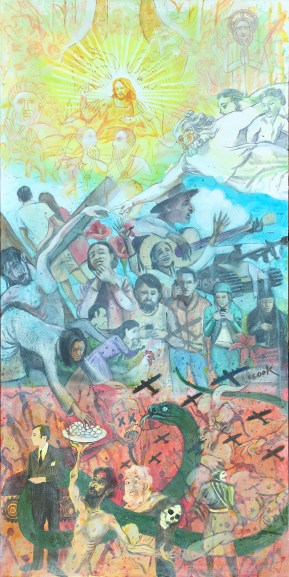
Three Worlds: Heaven, Earth & Hell – Chris Cook Artist
Chris Cook

Listen to the Catch Fire musings on the ‘I Think Speech‘ Podcast

Dear friends, Our painful blessings are cracking open holes in the sour & puckered mass hallucination mistakenly called reality. News of the soul’s true home is pouring in, infiltrating our increasingly lucid waking life. Wild ripe juicy eternity is flooding in. Our allies from the other side of the veil are lining up, awaiting our awakening. And as Heaven & Earth come together, as the dreamtime & daytime merge, as paradise & the underworld overlap, we register the exhilarating fact that we are actually the ones in charge  –you & I are in charge–  of making a brand new world. Not in some distant time or faraway place, but right here & right now.

Shamanism / ritual magic / sacred tree / heaven and hell / | Etsy
Shakte Mazepel

In the coming months, we’ll encounter events that require us to revise our understandings about the very nature of reality. Our imaginations will have to be ingenious & our hearts alert in order to keep up with the outlandish changes. To locate truth amidst relentless waves of propaganda, we’ll have to be fiercely disciplined & tenderly hate-free. To avoid being infected by popular delusions, we’ll have to cultivate compassionate lucidity, humble courage, & a determination to rouse our will.

The Sun at His Eastern Gate, 1820 Painting by William Blake
William Blake

We are primed to commune much more intimately with the hidden source of power that fuels life. We are close to meeting the requirements defined by visionary poet William Blake who wrote: “Unless the eye catch fire, God will not be seen. Unless the ear catch fire, God will not be heard. Unless the tongue catch fire, God will not be named. Unless the heart catch fire, God will not be loved. Unless the mind catch fire, God will not be known.”

Watch Me Catch Fire" by Marie Enger - Hero Complex Gallery
Marie Enger

Friends – Let’s catch fire, to enkindle a passion to know god in all her forms. And to nurture our home fires that we must keep ever burning, as well as the communal fire that we must gather around & feed with our very breath.

~hag

***

10:10 Testament by Sally Greenberg from “A living physiology” by Karl Konig – ‘The Light of thinking shining like a star’ – I will use this as part of my Thought Seed during the 10:10 Meditation. Thanks Sally! And friends, please feel free to share your inspirations. Blessings – See you in the light.

Young moon and Mercury adorn January evening twilight

16 January 2021 – “Speaking with the Stars”: Maybe you saw the Mercury (Occult Venus) last week, near Jupiter &Saturn, when these three worlds formed a planetary trio? Now Jupiter & Saturn are difficult to see in the glare of twilight. And Mercury has ascended higher in the western twilight& will be near the waxing crescent which is just returning to the evening sky after new moon on January 12-13. Find the horizon in the direction of sunset, & look for baby Bella Luna & Mercury to pop out into the evening twilight as dusk ebbs into darkness. The nearby bright star will be Fomalhaut in Piscis Austrinus the Southern Fish. Fomalhaut is sometimes called the Loneliest Star, but it’s not so lonely now!

***

Symposium Between heaven and hell. Religious and spiritual experiences in  the context of mental health care | Calendar | University of Groningen
Benny Forest

Rudolf Steiner’s Lectures on this day

ON THIS DAY IN HISTORY

The Royal Calendar: January 16, 2012

1412 – The Medici family is appointed official banker of the Papacy

Johannes Schöner - Wikipedia

1477 – Birthday & Deathday (1547 ) of Johannes Schöner, a renowned German polymath. He was a priest, astronomer, astrologer, geographer, cosmographer, cartographer, mathematician, globe &scientific instrument maker & editor/ publisher of scientific tests. He published of Copernicus’ “De revolutionibus” in Nürnberg in 1543. He enjoyed a European wide reputation as an innovative & influential globe maker & cosmographer- as one of the continent’s leading & most authoritative astrologers.

Portrait of Ivan The Terrible painted by Viktor Vasnetsov in “1897”. Ivan  IV was the first Tsar of Russia, giving h… | Russian history, Russian art,  Modern history
Victor Vanasnetov

1547 – Ivan the Terrible becomes Czar of Russia

FRANZ BRENTANO watercolor portrait" Canvas Print by lautir | Redbubble
Tyler Cantell

1838 – Birthday of Franz Brentano an influential German philosopher, psychologist, & priest whose work strongly influenced not only students Edmund Husserl, Sigmund Freud, Kazimierz Twardowski, Alexius Meinong, Carl Stumpf, Anton Marty, Christian von Ehrenfels, and Tomáš Masaryk, but many others whose work would follow &make use of his original ideas & concepts. Rudolf Steiner recalls the obituary he gave of Brentano as part of his lecture The Case for Anthroposophy where he also speaks about the Separation of the ‘Psychological from the Non-Psychological’ in Franz Brentano.

Arnold Böcklin - 123 artworks - painting

1901 – Deathday of Arnold Böcklin a Swiss symbolist painter. Rudolf Steiner speaks about him in an incarnation as an Arthurian Knight

After the Fall: Photos of Hitler's Bunker and the Ruins of Berlin | TIME

1945 – Adolf Hitler moves into his underground bunker, the so-called Führerbunker

Society Anthroposophy Worldwide 9/14

1954 – Birthday of Sergei O. Prokofieff – a Russian anthroposophist. He was the grandson of the composer Sergei Prokofiev. Born in Moscow, he studied fine arts & painting at the Moscow School of Art. He encountered anthroposophy in his youth, & soon made the decision to devote his life to it. Prokofieff, wrote his first book, Rudolf Steiner and the Founding of the New Mysteries, while living in Soviet Russia. After the collapse of the Soviet Union, he was a co-founder of the Anthroposophical Society in Russia. At Easter 2001, he became a member of the Executive Council of the General Anthroposophical Society in Dornach, Switzerland. Prokofieff was a prolific author; at the core of his work is an attempt to develop a deepened understanding for Christianity on the basis of Rudolf Steiner’s spiritual-scientific research. Prokofieff was a prolific writer leaving us a treasure trove of Works.

The Great Man That Was Toscanini - Terry Teachout, Commentary Magazine

1957 – Deathday of Arturo Toscanini an Italian conductor, renowned for his intensity, his perfectionism, his ear for orchestral detail & sonority, & his photographic memory.] He was at various times the music director of La Scala Milan, the Metropolitan Opera in New York, & the New York Philharmonic Orchestra. Later in his career he was appointed the first music director of the NBC Symphony Orchestra (1937–54), & this led to his becoming a household name through his radio & television broadcasts & many recordings.

ON THIS DAY: January 16, 2018 | Flowers For Socrates

1970 – Buckminster Fuller receives the Gold Medal award from the American Institute of Architects

***

Liberty; In the Form of The Goddess of Youth; Giving Support To The bald  Eagle / Edward Savage - Gilcrease Museum

Friends I’m feeling called to offer a presentation on the ‘Spirit of America’. Anyone want to work with me to bring it to your community & share it on zoom world wide?

Not 1 without the other

Light in a Dark place - Ahayah Purpose - Paintings & Prints, Abstract,  Other Abstract - ArtPal
Lete Ahaya

POD (Poem Of the Day)

~The truth
Of what we call our knowing
Is both light & dark…
Humans are always dying & waking…
The rhythm between, we call life…
Some miracle is about
To happen…

~hag

***

Here is today’s ‘I Think Speech‘ Podcast an important quote from Rudolf Steiner, Manifestations of Karma, LECTURE 8

***

Ablutions: A priest purifies the hands of another one, on an altar. A daily  ritual. Ancient Egyptian tomb. | Antike ägyptische kunst, Ägyptische kunst,  Alte kunst

“…the Egyptian-Chaldean period is repeated in our own…We may go back to the epoch of the Egyptian evolution, and there we find certain ritualistic ordinances and commands which appeared as given by the gods. And this they actually were. These ordinances related to certain ablutions which the Egyptians had to perform. This was a command of the gods, that found expression in a certain cult of cleanliness

COVID-19 Return to Work Hygiene: Wash Your Hands

We now again, in our own period, encounter hygienic measures such as are given to humanity but in our time, for materialistic reasons. Here we see a repetition of what was lost at a corresponding period in Egypt. The fulfilment of what happened earlier is represented in the general karma in a most remarkable manner. In ancient Egypt the laws of cleanliness were laws of Divine revelation. The Egyptian believed that he was fulfilling his duty to humanity by caring for his particular cleanliness at every opportunity. This preoccupation for cleanliness comes to the fore again today, but under the influence of a mentality which is entirely materialistic. Modern man does not think that he is serving the gods when he is obeying such rules, but that he is serving himself. It is nevertheless a reappearance of what went before.

Mumbai Artist Dhruvi Acharya is creating coronavirus-themed watercolour  paintings
Dhruvi Acharya

Thus all things are in a certain way cyclically fulfilled. If at a certain period people were not able to conceive certain measures against epidemics, these were times at which men could not do so because, according to the general wise world plan, the epidemics had to take effect in order to give human souls an opportunity of balancing what had been effected through the ahrimanic influence and certain earlier luciferic influences. If other conditions are now being brought about, these too are subject to certain great karmic laws. So we see that these matters cannot be regarded superficially.

How does this agree with our statement that if someone seeks an opportunity of being infected in an epidemic, this is the result of the necessary reaction against an earlier karmic cause. Have we the right now to take hygienic or other measures?

This is a profound question, and we must begin by collecting the necessary material for replying to it. We must understand that where the luciferic and ahrimanic principles are co-operating, whether concurrently or over longer periods, or where they are working against each other, there are manifested certain complications in human life. These complications appear under forms so diverse that we never see two identical cases. If we study human life, however, we shall find our way in the following manner: if in a particular case we try to discover the combined activity of Lucifer and Ahriman, we shall always find a thread by which this connection will become clear. We must discriminate clearly between internal and external man. We must examine the continuity in which karma is accomplished, and we must at the same time understand that we have still the possibility of influencing our inner being by means of certain karmic influences, so that in future a new karmic compensation may be prepared by the inner being.

Dhruvi Acharya, Painting in the Time of Corona, 26 April 2020, lockdown day  33, 2020 | Chemould Prescott Road
Dhruvi Acharya

It may well happen that we, following for a time a downward grade, beget evil. We at first descend in order to develop the contrary impetus that will cause us to re-ascend. Let us suppose that a being, by yielding to certain influences, tends towards uncharitableness. This uncharitableness will in a later life appear as karmic result, and will develop inner forces in his organism.

We can then act in two ways — consciously, or else unconsciously. In our epoch we have not progressed so far as to do it consciously. With such a person we can take precautions by which these characteristics in his organism, derived from uncharitableness, will be driven out and we may act in such a way that the effect that is expressed in the external organism as a lack of charity will be counteracted. By these means, however, the soul will not be cleansed of all uncharitableness, but only the external organ of uncharitableness will have been expelled. For if we do nothing further, we shall have accomplished only half of our task, perhaps even nothing at all, or we may even do harm. We may perhaps have helped this person physically, externally, but we shall not have given succour to his soul. Now that the physical expression of uncharitableness has been removed he will not be able to give expression to this uncharitableness, but he will have to retain it within his inner organism until a future incarnation.

Dhruvi Acharya paints the fear of pandemic
Dhruvi Acharya

Let us suppose that a great number of people, because of uncharitableness, had been impelled to absorb certain infectious germs, so that they succumbed to an epidemic. Let us further suppose we were in a position to protect them from this epidemic. We should in such a case preserve the physical body from the effects of uncharitableness, but by doing this we have not removed the inner tendency towards uncharitableness.

Nature Morte – Dhruvi Acharya
Dhruvi Acharya

If we want to bring a true healing, we must also undertake the duty of influencing the soul in such a way as to remove from it the tendency towards a lack of charity, or the disease will go deeper into the soul.

The organic expression of uncharitableness is killed in the external bodily sense for instance by vaccination against smallpox, but the soul continues to be sick. In one period of civilisation, when there prevailed a general tendency to develop a higher degree of egotism, and uncharitableness, an epidemic made its appearance. Such is the fact investigated by Spiritual Science. In anthroposophy it is our bounded duty to give expression to the truth.

A Postcard from Delhi - Contemporary Art Society
Dhruvi Acharya

Now it will be clear why in our time the desire for the protection of vaccination appeared. We also understand why, among the best minds of our time, there also exists a kind of aversion to vaccination. This aversion corresponds to something within, and is the external expression of an inner reality, that seeks to karmicly rid itself of the cause of the disease.

So if on the one hand we destroy the physical expression of a previous fault, we should, on the other hand, undertake the duty of transforming the materialistic character of such a person by means of a corresponding spiritual education. This would constitute the indispensable counterpart without which we are performing only half our task. We are merely accomplishing something to which the person in question will himself have to produce a counterpart in a later incarnation. If we destroy the susceptibility to smallpox, for instance, we are concentrating only on the external side of karmic activity.

Now Showing > Dhruvi Acharya | INDIAN BY DESIGN
Dhruvi Acharya

If on the one side we go in for hygiene, it is necessary that on the other we should feel it our duty to contribute to the person whose organism has been so transformed, something also for the good of his soul. Vaccination will not be harmful if, subsequent to vaccination, the person receives a spiritual education. But if we concentrate upon one side only and lay no emphasis upon the other, we weigh down the balance unevenly. We see how essential it is that we should not undertake one task without the other.

Here we approach an important law of human evolution which acts so that the external and the internal must always be counter-balanced, and that it is not permissible to act with regard to the one only, leaving the other out of consideration. We here get a glimpse of an important relationship, and yet we have not even arrived at the significance of the question: ‘What is the relationship between hygiene and karma?’ As we shall see, the answer to this question will lead us still further into the depths of karma, and we shall further see that there exist karmic relationships between man’s birth and death. In addition, other personalities influence a human life, and man’s free will and karma must be in harmony. ~ Rudolf Steiner, Manifestations of Karma, LECTURE 8

***

14 January 2021 – “Speaking with the Stars”: In bright twilight, look low in the southwest for the thin crescent Moon aiming her curve lower right toward Mercury & disappearing Jupiter.

Above Orion shines orange Aldebaran with the large, loose Hyades cluster in its background. The Pleiades higher above.